
You receive a message on a forum or a sponsored ad: “Earn extra income by packing samples from home.” The offer seems simple, with no qualifications required and a flexible schedule. Before responding, it’s important to understand what is really behind these proposals and what distinguishes a legitimate activity from a financial trap.
Housing Compatibility and Legal Status for Home Packing
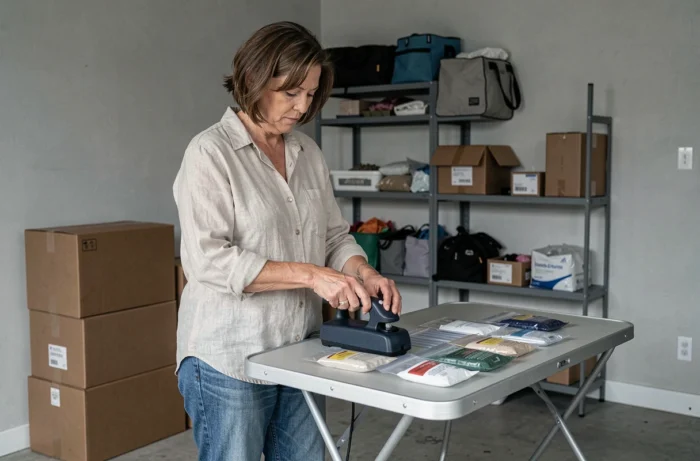
Before even looking for an offer, one encounters a constraint that most ads gloss over: the housing must be compatible with a packing activity. Storing boxes of samples, handling packing materials, and shipping parcels requires dedicated space.
In France, it is possible to conduct a professional activity from home, but only if it remains compatible with residential use. The rental lease, co-ownership regulations, or urban planning rules may prohibit this type of activity. Checking your lease and co-ownership regulations is a mandatory prerequisite before any registration.
The status of micro-entrepreneur remains the most common way to invoice for this type of service. You declare the activity, obtain a SIRET number, and invoice per task. Without this framework, any payment received for packing samples places the worker in a gray area, or even in illegality. Serious companies that outsource packing always require a declared status.
When considering working from home in sample packing, this administrative question should come first, well before the question of income.
Reports of Fraud on the Rise Since 2024 Regarding Home Packing

Online fraud observatories report a sharp increase in reports since 2024 concerning salary supplement offers related to sample packing and mailing. This increase documented by several specialized sources confirms that the phenomenon is not subsiding; on the contrary.
The most common mechanism operates in three stages. First, an ad promises attractive pay for simple work. Next, an exchange via email or phone builds trust. Then comes the request for payment: processing fees, purchase of starter materials, or an advance on a packing kit. Any offer that asks for money from the candidate is a scam, without exception.
The primary targets remain job seekers, easily identifiable on job listing sites. Scammers exploit financial distress and the promise of accessible work without a diploma. Feedback varies on this point, but several testimonies converge: once the money is paid, the “contractor” disappears or sends a check that cannot be cashed.
Legitimate Sample Packing Offers: What Really Exists
The reality of the market is harsh. The automation of logistics chains has significantly reduced the volume of packing tasks assigned to individuals. Large logistics companies prefer mechanized workshops for reasons of traceability, speed, and quality control.
Occasional tasks still exist, but they share specific characteristics:
- They come from an identifiable company with a verifiable SIRET number, not from an individual or an anonymous intermediary
- They never ask for financial advances or prior purchases of materials from the candidate
- The announced pay remains modest (a few cents per unit for mailing, a bit more for product packing), far from the promises of comfortable income
- A contract or order form is provided before the start of the service, specifying volumes, deadlines, and payment conditions
Authentic offers are almost never found on social media or in general public classifieds. They circulate through professional word-of-mouth, through service platforms for businesses, or through direct contact with mailing and promotional logistics companies.
Checklist Before Accepting a Packing Assignment
Rather than listing generic advice, here are concrete checkpoints to apply when faced with an offer that seems serious:
- Search for the company’s name in legal databases (Infogreffe, Societe.com) to confirm its legal existence and declared activity
- Check that the contact uses a professional email address linked to the company’s domain name, not a generic Gmail or Outlook address
- Refuse any request for payment, regardless of the reason given (materials, training, deposit, administrative fees)
- Require a written document (service contract, order form) before starting any task
- Ask for the contact details of other providers who have previously worked with this company
A legitimate contractor never refuses to provide their legal contact information. If the person evades the question of the SIRET number or the contract, it is a sufficient warning signal to cut off contact.
Realistic Income and Limits of Home Packing Work
Even in the context of a legitimate assignment, the income generated by packing samples at home remains modest. Piecework pay involves large volumes to reach a few hundred euros per month. The tasks are often irregular, linked to occasional promotional campaigns.
The time spent on packing, stock management, and shipping is rarely compensated proportionally. This type of activity does not replace a salaried job, and ads that suggest otherwise misrepresent the real potential.
For those seeking extra income from home, other avenues offer more regularity: online services, digital micro-tasks, or declared service offerings as a micro-enterprise in a specific area of expertise.
Sample packing work at home has not completely disappeared, but it occupies a narrow niche, poorly paid and saturated with scams. Keeping this reality in mind allows for approaching each offer with the necessary perspective, rather than with the hope that the ad is the exception.