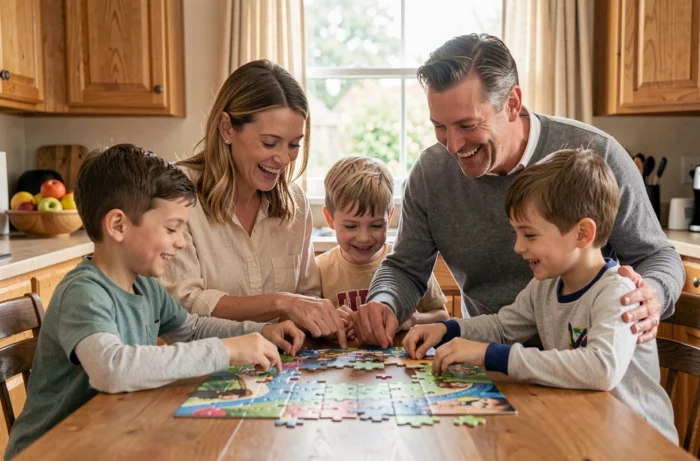
The mental availability of the parent during a shared activity weighs more on the quality of the bond than the time spent together. This finding, documented in studies published in Frontiers in Psychology, changes the way family activities are conceived: a short format where each member is fully engaged is better than a long afternoon where phones capture the adults’ attention.
Cooperative video games in the family: an underestimated bonding tool
Co-playing video games remains the great absent from classic family activity lists, systematically categorized as screen time to limit. We observe a clear gap between public perception and available data. About 74% of gaming parents believe that playing with their children strengthens family bonds, and 69% report better understanding their children through this practice.
The mechanism is precise: a cooperative game (solving a puzzle together, defending a base, building a world) mobilizes verbal communication, role distribution, and collective management of failure. These are exactly the skills worked on in board games, transposed into a digital environment that children often master better than parents.
We recommend prioritizing cooperative games over competitive ones, with sessions lasting 20 to 30 minutes. Several catalogs of cooperative family games are available on specialized platforms like https://letsplayfamily.fr/, which lists titles suitable for different age groups.
The goal is not to replace physical or manual activities but to integrate video gaming into the family repertoire without guilt, provided that the parent is active in the game and not just a spectator.

Short daily rituals: formats and frequency to create complicity
An effective family ritual lasts between five and fifteen minutes and occurs at the same time each day. Regularity takes precedence over the ambition of the format. A quick card game after dinner, a four-handed drawing before bedtime, a riddle during the car ride: these micro-activities build a foundation of complicity that exceptional outings cannot replace.
The common trap is to plan an activity that is too long or too complex, which the end-of-day fatigue makes impossible to maintain. We recommend testing a ritual for two weeks before considering it established.
Examples of immediately testable rituals
- The “one-word journal”: each family member writes a word summarizing their day in a shared notebook, then reads it aloud. No material preparation, duration under five minutes, but daily verbalization creates a space for listening.
- The minute cooking challenge: choose three random ingredients from the refrigerator and invent a recipe together. The result matters less than the collective negotiation over choices.
- The “question box”: a jar containing open-ended questions (what superpower would you choose? what is your best memory of the week?). One question is drawn each evening. Open-ended questions generate deeper exchanges than silent activities.
Board games and emotional expression: concrete selection criteria
Not all board games are equal in strengthening family bonds. Purely strategic games (chess, management games) develop individual thinking but produce little emotional interaction. We lean towards three specific categories of games.
The first: cooperative narrative games, where players build a story together. They require listening, bouncing ideas, and accepting others’ thoughts. The second: emotional expression games like those that use emotion cards to verbalize feelings. They are particularly useful with children from seven or eight years old, an age when the ability to reflect on oneself and others becomes more complex.
The third: improvisation games, which place each player in a situation of comedic vulnerability. Shared laughter remains one of the most powerful relational cements in a family context.
What distinguishes a good family game from a game that ends up in the closet
The duration of the game should not exceed 30 minutes for children under 10 years old. Beyond that, attention wanes, and the game becomes a chore. The rules should fit on one page. If a parent spends more time explaining than playing, the game will be abandoned after two uses.
Price is not an indicator of relational quality. Some games under fifteen euros generate more interactions than a sixty-euro game overloaded with materials.
Nature activities for families: moving beyond the “Sunday outing” format
The classic Sunday walk suffers from a structural flaw: it relies on walking, an activity that children rarely associate with pleasure. Adding a playful layer transforms the outing into a shared experience.
Geocaching, photo hunts (spotting and photographing ten different plant species), or building ephemeral shelters turn nature into a collaborative playground. The common goal gives meaning to the outing and maintains children’s engagement.
We observe that families who anchor their nature outings in a recurring project (a herbarium over the year, a seasonal sketchbook) maintain the practice longer. The project provides continuity between outings and nourishes conversations during the week.
The question of frequency also matters. Two short outings of 45 minutes during the week, even in an urban park, produce more moments of complicity than a monthly three-hour hike where half the family drags their feet.
Family bonds are built in the repetition of shared micro-moments, not in spectacular events. Choosing two or three activity formats that work for your family, embedding them in the weekly routine, and resisting the temptation to multiply new experiences: this is the strongest strategy to anchor complicity over time.