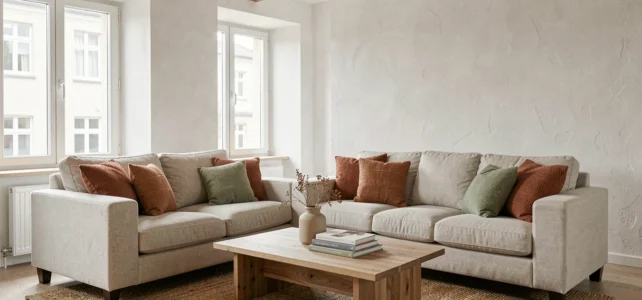
Interior decoration relies on a balance between the volumes of a room, the chosen materials, and the available light. Transforming an interior doesn’t necessarily require a significant budget or a heavy renovation: precise choices regarding colors, textures, and furniture are enough to change the perception of a space. Current decor trends reflect this logic, favoring targeted gestures over complete renovations.
Second-hand and decoration: a market influencing design choices
The reflex to buy new furniture to redecorate a living room or bedroom is clearly declining. According to a study published in June 2026 by Leboncoin Solutions Pro, one in four pieces of furniture sold in France is now second-hand. This figure indicates a lasting shift in habits, not just a passing trend.
About half of the buyers planning to invest in furniture or decoration in the next twelve months are considering second-hand options to preserve their purchasing power. The second-hand furniture market is worth approximately 1.3 billion euros in France, and 71% of French people report having no issues buying second-hand furniture.
To fuel your search for pieces and ideas, decorating on Incroyable Maison helps identify stylistic directions before hunting for bargains. Combining specific inspiration with a second-hand purchase often yields better results than browsing a new catalog without filters.
This economic context is also changing the nature of decor projects. Rather than renewing an entire living room, many individuals focus on one or two standout pieces (a sideboard, an armchair, a coffee table) and build the rest of the ambiance around them. The IPEA’s economic note from May 2026 confirms this trend with a 6.9% decrease in the value of furniture purchases, the most significant drop since the beginning of the year.
Heritage style: mixing old and contemporary in a living room
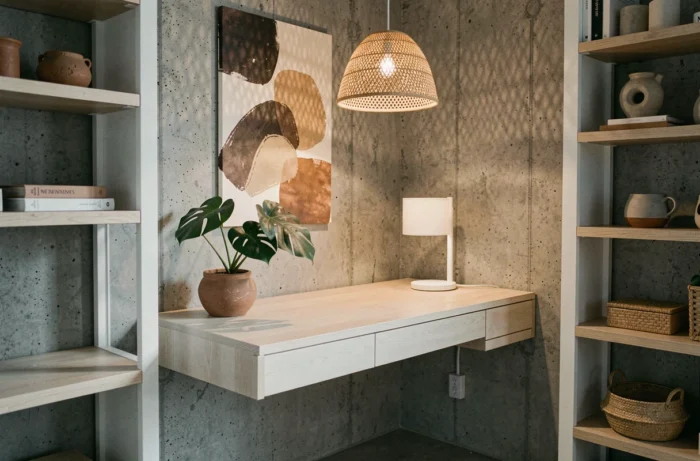
Among the directions shaping decoration in 2026, heritage style stands out for its layering logic. The principle is simple: combine antique or vintage pieces (a gilded mirror, a 1960s sideboard, a brass lamp) with a contemporary setting featuring clean lines.
This trend is not based on nostalgia. It starts from the observation that antique furniture, made from dense wood species and with solid joinery, provides a visual presence that standard particle board furniture does not. A vintage bridge armchair, upholstered in a contemporary fabric, becomes a focal point in a living room without requiring any renovation.
Three guidelines for incorporating an antique piece
- Limit to two or three antique objects per room to avoid a flea market effect. The rest of the furniture should remain understated, with straight or slightly curved lines.
- Harmonize by material rather than by era: a brass lamp base pairs well with a walnut coffee table, even if fifty years separate them.
- Prefer accent furniture (end tables, consoles, plant stands) to test the mix before investing in a statement piece.
Heritage style works particularly well in living rooms and entrances, where a single antique object is enough to visually structure the space.
Natural color palette: moving beyond uniform beige
Sand, terracotta, sage green, and aquatic blue tones dominate the palettes offered by brands and designers this year. These natural colors provide a calming effect without closing off the space, as long as one avoids falling into complete monochrome.
A common mistake is painting all four walls the same beige and matching curtains, cushions, and rugs in similar shades. The result is flat. To create depth, one must introduce a strong contrast on at least one element: an accent wall in supported terracotta, an olive green sofa in a sand-dominated living room, or coral cushions on a light gray armchair.
Combining warm and cool tones
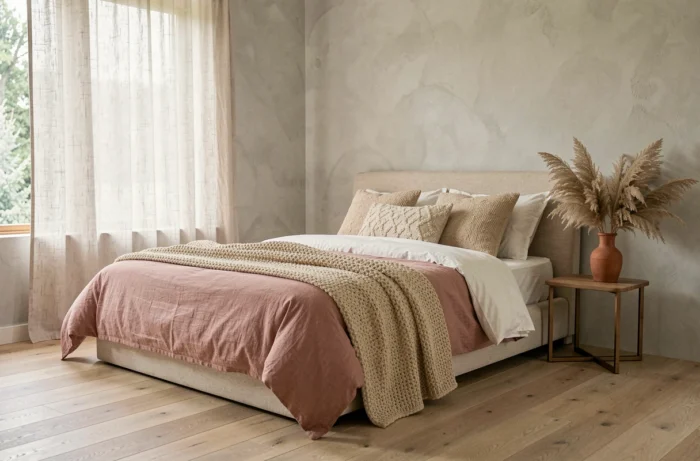
An interior gains character when the palette mixes a warm dominant (beige, ochre, terracotta) with a cool accent (blue-gray, verdigris). This slight tension between the two registers prevents monotony. The ideal ratio is around three-quarters of warm tones to one-quarter of cool tones, without rigid calculations.
Brighter colors like butter yellow or pistachio work well in small touches on replaceable objects (vase, throw, frame). Painting an entire wall in pistachio is a bigger commitment and requires validating the shade in natural morning and evening light before deciding.
Raw materials and textures in interior decoration
Wood, washed linen, stone, handmade ceramics: raw materials remain at the forefront of decor trends. Their appeal goes beyond aesthetics. A textured material absorbs and diffuses light differently than a smooth surface, which alters the ambiance of a room without touching the walls or lighting.
A wrinkled linen cushion on a smooth velvet sofa creates an immediate tactile contrast. A raw wood table placed on a polished concrete floor produces the same effect. The operational rule is to combine at least three different textures in each main room: a soft material (textile), a rigid material (wood, metal), and a mineral or plant material (stone, rattan, ceramic).
- Rattan and caning are making a strong comeback in headboards, seating, and lightweight storage. Their weaving filters light and visually lightens a piece of furniture.
- Handmade ceramics, with their surface irregularities, are gradually replacing smooth industrial accessories (vases, bowls, candle holders).
- Washed linen, used in curtains or bedding, provides a natural drape that softens spaces with very geometric lines.
The combination of these materials with the natural colors described above forms the basis of most current interiors. Choosing to prioritize second-hand options for some of these pieces, particularly solid wood furniture and ceramic objects, remains the most coherent strategy for a controlled budget and a lasting result.