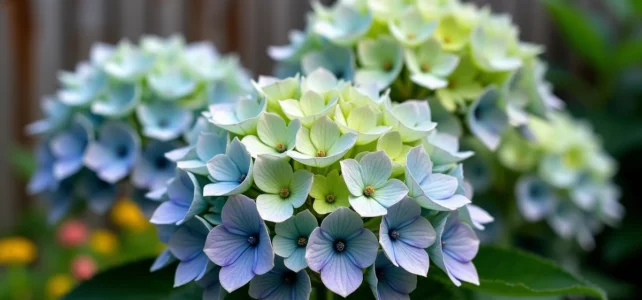
An hydrangea whose flowers turn green raises a simple question: does the phenomenon stem from a cultural problem or the plant’s natural cycle? Answering this requires distinguishing several mechanisms, as the greening of hydrangea flowers does not have a single cause. The soil pH, the watering water, the cultivated species, and the flowering stage each play a measurable role.
Factors of greening in hydrangea flowers: summary table
| Factor | Mechanism | Concerned species | Reversibility |
|---|---|---|---|
| Natural senescence (end of flowering) | Pigments degrade, chlorophyll takes over in the sepals | All species of Hydrangea | No (normal cycle) |
| Soil pH too neutral or alkaline | Aluminum becomes unavailable, the color fades then turns dull green | Hydrangea macrophylla, Hydrangea serrata | Yes, by acidifying the soil |
| Hard water for irrigation | Limestone raises the pH around the roots, even in acidic soil | Hydrangea macrophylla, Hydrangea serrata | Yes, by changing the water source |
| Excess nitrogen fertilizer | Promotes vegetative growth at the expense of floral pigmentation | Most species | Yes, by rebalancing fertilization |
| Variety naturally green at the end of the cycle | Some cultivars (paniculata, some macrophylla) turn green genetically | Hydrangea paniculata, some macrophylla | No (varietal characteristic) |
This table highlights a often underestimated point: greening is not always a warning signal. When flowers turn green at the end of summer, after several weeks of blooming, it is most often senescence, a perfectly normal process. Understanding why my hydrangea is turning green first requires identifying when the change appears in the season.
Floral senescence or soil problem: distinguishing the two cases
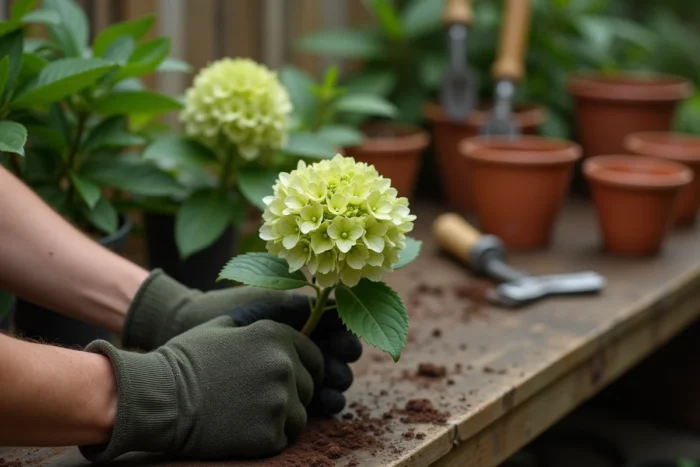
The most common confusion is attributing greening to the soil when it actually stems from the natural aging of the flowers. In hydrangeas, the visible “petals” are actually sepals. As flowering progresses, these sepals lose their pigments (anthocyanins) and the chlorophyll they contain becomes visible again.
A gradual greening starting from July-August is normal. It affects all species of Hydrangea, including white varieties that do not react to pH.
On the other hand, early greening, as soon as the flowers open or at the peak of flowering, points to an imbalance in the soil or watering. Two concrete clues help to decide:
- The flowers never reached their expected color (pink, blue, or red) before turning green: the soil or water is likely to blame
- The flowers were colored for several weeks then slowly turned green: this is the senescence cycle, no intervention is necessary
- Greening affects only one plant while its neighbors remain colored: check the drainage and the nature of the soil in that specific location
Role of watering water in the color of hydrangeas
Gardening guides emphasize soil pH and the availability of aluminum to explain the color of hydrangeas. The link is well documented: an acidic soil rich in aluminum produces blue flowers, while a neutral to alkaline soil leads to pink. However, a parameter often overlooked can nullify all correction efforts: the quality of the watering water.
Hard water, common in many regions of France, gradually raises the pH of the soil around the roots. Even initially acidic soil eventually neutralizes after several seasons of watering with tap water. The result: the flowers fade, lose their vibrant hue, and may turn dull green.
Identifying and correcting the water problem
Rainwater remains the best option for watering hydrangeas. It is naturally low in minerals and slightly acidic. Storing rainwater in a collector allows for covering watering needs during the blooming season.
When rainwater is not available, adding a little white vinegar or lemon juice to the watering water helps lower its pH. Surface heather soil, renewed each spring, also helps maintain soil acidity.
Hydrangea species and sensitivity to greening
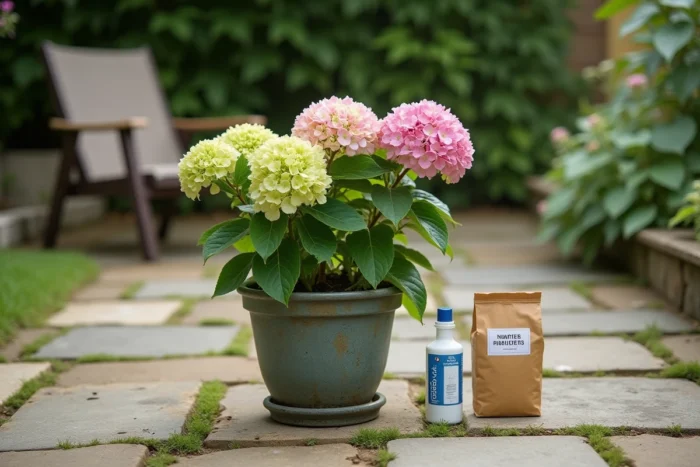
Not all species behave the same way with respect to soil and watering. Only Hydrangea macrophylla and Hydrangea serrata change color based on pH. Other common species in the garden, such as Hydrangea paniculata or Hydrangea quercifolia, do not have the same pigments and do not react to acidic amendments or the addition of aluminum.
Hydrangea paniculata, for example, produces white flowers that turn pink and then green naturally at the end of the cycle. Trying to change the color of this species through the soil is futile.
White varieties: a special case
White hydrangeas (macrophylla or paniculata) do not contain the anthocyanins necessary for turning blue or pink. Their greening at the end of the season is purely genetic. Adding crushed slate, aluminum sulfate, or special “blue hydrangea” fertilizer will have no effect on these cultivars.
Correcting the color of a greening hydrangea macrophylla
For Hydrangea macrophylla and serrata whose greening is related to the soil, corrections must be anticipated. Amendments should be made in the fall or late winter, never during full bloom. Acting in June when the flowers are already open has no visible effect on the current season.
- To obtain or maintain blue flowers: add aluminum sulfate and mulch with crushed slate or heather soil to acidify the soil
- For pink to red flowers: slightly raise the pH with a mild lime amendment, and ensure that aluminum is low in availability
- To prevent early greening: water with rainwater, limit nitrogen fertilizer, and favor a fertilizer rich in potash that supports pigmentation
Color correction requires at least a full season to produce visible results. A hydrangea transplanted to a new garden may take two to three years to stabilize its hue, as its roots colonize a sufficient volume of soil.
The greening of a hydrangea primarily tells the story of its soil, its water, and its floral age. A quick diagnosis, based on the timing of the green appearance and the cultivated species, avoids unnecessary corrections and directs towards the only actions that will have a real effect the following season.