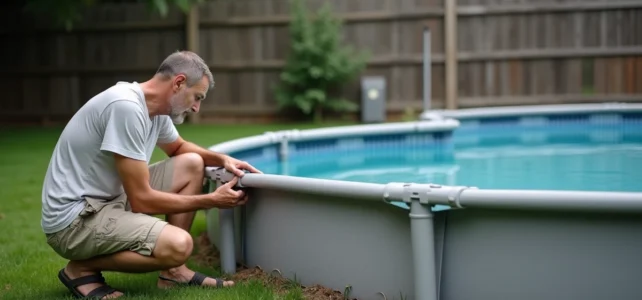
An above-ground pool that tilts by a few centimeters poses more than just an aesthetic problem. The asymmetric deformation of the top ring accelerates the wear of the liner at stress points, and the poorly distributed lateral pressure can cause a gradual sinking of the ground beneath the structure. We regularly observe that the reflex to compensate with wedges or boards worsens the situation instead of correcting it.
Tolerance level threshold for above-ground pools: when to really act
The question of an acceptable threshold comes up consistently. From feedback shared by installers in specialized groups, a difference of one to two centimeters between two legs remains stable over time, provided the ground is homogeneous. The pool deforms slightly, the water level compensates, and the structure does not experience abnormal fatigue.
Beyond three to four centimeters, the situation changes. The weight of the water (several tons even for a modest-sized model) compresses the ground unevenly. The low side sinks further, the high side rises, and the gap widens over the weeks. At this stage, we recommend draining the pool and reworking the ground, without seeking an intermediate solution.
To measure the gap accurately, a laser level or a bubble level placed on a one-and-a-half-meter masonry rule provides a reliable result. Measuring the water height directly on each side of the ring is misleading: wind and liner deformation distort the reading.
If you are looking for solutions for a tilting above-ground pool, the first step is always this level diagnosis before considering any intervention.
Ground preparation: the layered method that prevents tipping
The ground must be prepared before installation, not after. Techniques for leveling an already filled pool are makeshift at best. The method favored by installers for several years is based on a simple principle: excavate to a stable level, never raise.
Successive layers and compaction
The preparation protocol follows a precise order:
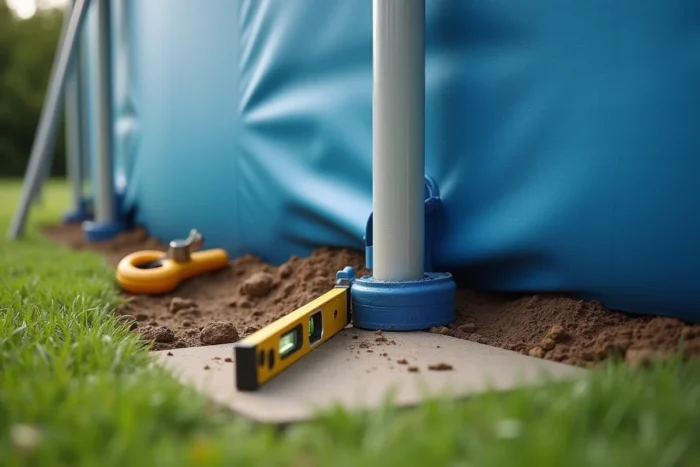
- Excavation of the ground until reaching a hard and homogeneous soil layer, removing topsoil, roots, and stones
- Placement of a geotextile tarp that allows rainwater to pass but prevents stones from rising and destabilizing the sand
- Layer of quarry sand (not beach sand, which is too fine and unstable) compacted mechanically with a vibrating plate or a weighted lawn roller
- Checking the level with the masonry rule in several directions before laying the ground mat
Mechanical compaction makes all the difference. Compacting the sand by hand or foot leaves soft areas that give under load. A vibrating plate can be rented for a modest daily cost and transforms the stability of the result.
Common mistake: raising instead of excavating
We observe a common reflex to add sand or soil on the low side to “level” the height. This raising creates a loose layer that compresses under the weight of the water. The ground returns to its initial slope in a few days, sometimes in just a few hours after filling. A raised ground cannot sustainably support several tons of water.
Straightening a filled above-ground pool: realistic actions
Filling represents a significant volume of water, and the idea of draining everything to start over is understandably daunting. A few interventions remain possible without complete drainage, provided the level difference is moderate.
Partial drainage and repositioning
For a difference of two to three centimeters, draining the pool to one-third of its height is sometimes enough to lighten the structure for movement. The flexible liner of an above-ground pool allows, with two people, to gently pull the pool toward a flatter area. Never pull a full above-ground pool: the liner tears at the attachment points and the base deforms.
After repositioning, check the level before resuming filling. If the ground remains soft or uneven, the problem will return.
What not to do
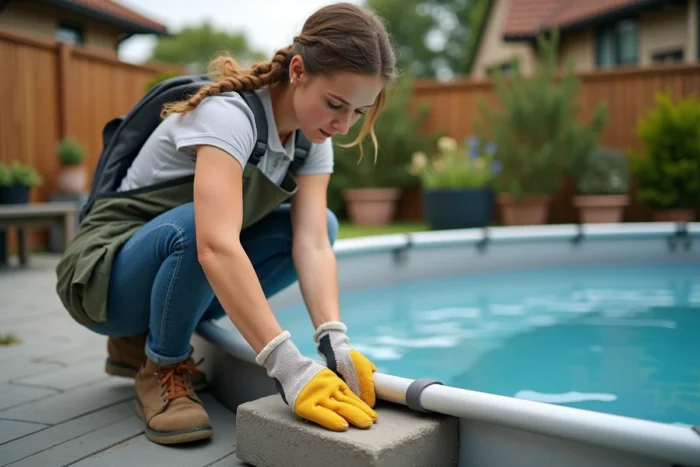
Shimming the legs of the structure with cinder blocks, bricks, or boards concentrates the weight on reduced support points. The cinder block sinks into the soft ground, the board bends under the load, and the pool becomes even more unstable than before. Polystyrene or foam slabs sold as ground mats do not correct a flatness defect: they cushion but do not level anything.
Sloped ground in the garden: adapting the choice of above-ground pool
Not all gardens are suitable for a large diameter round above-ground pool. The wider the pool, the more even the slightest slope translates into a visible and problematic level difference. On naturally sloped ground, reducing the diameter or opting for an oval model limits the extent of the imbalance.
Tubular models with a metal frame tolerate micro-irregularities in the ground better than inflatable ring models, whose rigidity relies solely on air pressure and the weight of the water. An under-inflated ring on uneven ground bends instead of maintaining the shape of the pool.
On ground with more than five centimeters of elevation difference in the installation area, excavation becomes earthworks. At this stage, the question arises of switching to a rigid-walled above-ground pool, whose structure can withstand lateral stresses without relying on the ground for its geometry.
The choice of installation site deserves as much attention as the choice of model. A well-placed above-ground pool on properly prepared ground does not tilt, even after several seasons. The problem almost always comes from the ground, never from the pool itself.