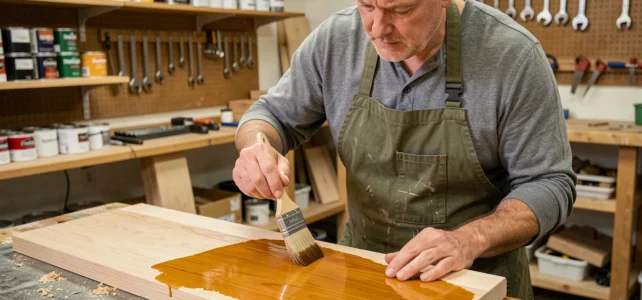
Polyurethane resin gives a wood stain mechanical properties that alkyd or acrylic binders alone cannot match on exposed wood. The Parkside polyurethane stain utilizes this binder to provide outdoor durability that surpasses many entry-level stains, while remaining accessible to DIY enthusiasts equipped with standard tools.
Polyurethane Resin and Wood Stain: What the Binder Changes
Traditional stains rely on alkyd resins (solvent phase) or acrylics (water phase). Polyurethane changes the game on three technical parameters: abrasion resistance, film elasticity, and adhesion on dense fibers.
A polyurethane binder forms stiffer molecular bridges between polymer chains. The resulting film better withstands the wood’s expansion-contraction cycles without micro-cracking. On a terrace or siding exposed full south, this controlled elasticity delays the powdering and flaking that we often observe with pure alkyds after two or three seasons.
Adhesion on exotic or dense softwoods (larch, Douglas fir) often poses a problem for standard acrylic stains. Polyurethane penetrates less deeply than the latter, but its mechanical anchoring on the surface remains superior once the film is cured. This is a deliberate compromise: less penetration, but a more cohesive surface film.
We recommend considering the Parkside polyurethane stain for wood as a relevant option for medium to hard woods outdoors, precisely because its polyurethane binder corrects the common weaknesses of acrylic formulations on these species.
Parkside Polyurethane Stain: Performance in Real Conditions
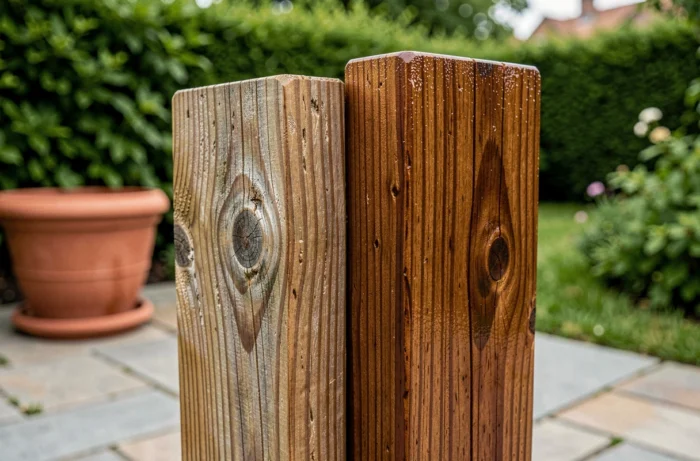
User feedback converges on several observations. The finish after two coats is semi-matte, slightly satin, with a grain that remains visible. The texture does not hide knots or defects in the wood, which distinguishes it from an opaque paint.
In terms of application, the viscosity of the Parkside product allows for work with a wide brush or a short-haired roller without excessive dripping. The drying time between coats falls within the usual range for solvent-based polyurethane stains. Light sanding (fine grit) between coats significantly improves the adhesion of the second pass.
Regarding durability, expert and experienced DIYer opinions highlight that the performance on exterior wood surpasses that of comparable-priced acrylic stains. However, UV resistance remains dependent on the chosen shade: clear or very light stains offer less UV protection than dark shades, regardless of the binder. This point is not unique to Parkside, but it is often underestimated when making color choices.
COV Regulatory Pressure and Choosing a Polyurethane Stain
European directives on volatile organic compounds push manufacturers towards formulations with reduced solvent content. The wood coating market in Europe is shifting towards water-dilutable or UV-curing systems. However, conventional solvent-based polyurethanes remain dominant in applications where mechanical adhesion on wood is a priority.
In this context, Parkside positions itself by offering a product whose formulation complies with current VOC thresholds while retaining the advantages of a polyurethane binder. For a compliance-conscious user, this means there is no need to switch to a pure acrylic stain to meet current regulatory requirements.
Hybrid and bio-based polyurethanes are progressing, but in practice, conventional polyurethanes still represent the largest share of volume demand in the European Union for adhesives and wood coatings. The Parkside stain fits into this market reality: a proven formulation, not a breakthrough technology, but a consistent performance-compliance ratio.
Selection Criteria Before Purchase: Parkside Polyurethane Stain or Alternative
Choosing between Parkside and a competing stain (V33, Bondex, Xyladecor) is not just about the price per liter. We suggest checking several technical parameters before any purchase:
- The type of target wood: on softwoods (pine, fir), a penetrating acrylic stain may suffice. On dense or exotic woods, the Parkside polyurethane takes the advantage due to its more durable surface film.
- Exposure: a north-facing siding with little UV exposure does not require the same durability as a full south terrace. Parkside is especially justified on the most exposed faces.
- Planned renewal: a polyurethane stain is more difficult to sand than an acrylic during renovation. If you plan to change shades frequently, this parameter weighs in the balance.
- Compatibility with prior treatment: on wood already treated in autoclave or saturated with oil, an adhesion test on a masked area is mandatory before full surface application.
Premium brands like Sikkens or Xyladecor offer high-end polyurethane ranges, but at a significantly higher cost. Parkside occupies a middle ground where the polyurethane binder is present without blowing the budget.
Common Application Mistakes with Polyurethane Stain
Applying a polyurethane stain like an acrylic stain generates avoidable defects. The first mistake concerns the substrate: damp wood (too high moisture content) prevents the proper curing of the polyurethane. The film remains tacky and never reaches its nominal hardness.
The second mistake is the layer thickness. Two thin coats are better than one thick coat: a film that is too thick in polyurethane creates internal tensions that lead to premature flaking. The brush should be wiped regularly to maintain a moderate load.
The third point: application temperature. Below ten degrees, polymerization slows significantly. Above thirty degrees, the solvent evaporates too quickly, and the film sets before it has properly penetrated the first fibers.
The Parkside polyurethane stain meets a specific need: to durably protect exposed exterior wood, with a binder that surpasses acrylics on dense species, without reaching the price of professional ranges. Its main advantage remains this compromise between mechanical film resistance and accessibility, provided that the application rules specific to polyurethanes are respected.