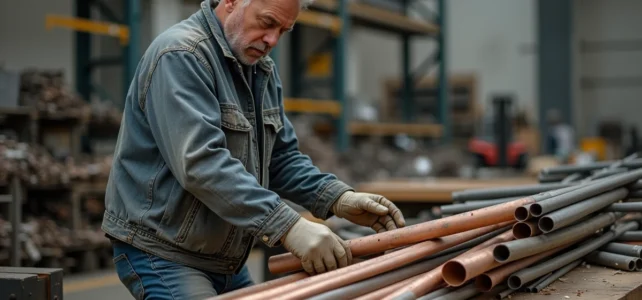
You have accumulated copper, brass, or old scrap metal in your workshop, and you are wondering how much Derichebourg might pay you for it. The classic reflex is to load everything into a trailer and head to the nearest center. The problem is that the displayed rate at the counter depends on several parameters that you can influence even before leaving your garage.
Rate by collection basin: why Derichebourg does not pay the same price everywhere
A detail that most guides overlook: Derichebourg adjusts its prices by agency, not at the national level. Each collection site applies a rate indexed to global prices but modulated according to local demand, the proximity of foundries, and the competition from scrap dealers in the area.
Specifically, the same lot of stripped copper can be bought back at a significantly different rate between two agencies located just a few dozen kilometers apart. This collection basin logic also extends across borders: Derichebourg Belgium publishes its own indicative prices by collection point, and the differences with French agencies are documented, particularly for copper, brass, and aluminum.
For artisans, farmers, or SMEs handling several hundred kilos, comparing the metal prices at Derichebourg in 2026 with those of a local depot or a cross-border agency can represent a significant gain on the total.

Metal prices and recycler margin: understanding the purchase price calculation
You may have noticed that the price displayed at a scrap dealer never matches the copper or aluminum price you check online? That’s normal. The recycler buys your metal at a price lower than the international rate, then sells it to steel mills or foundries. Their margin is the difference between these two amounts.
At Derichebourg, this difference varies according to three factors:
- The current price of the metal in question, indexed to international references like the Turkish Scrap Index for scrap or the London Metal Exchange for copper and aluminum.
- The volume brought: a lot of several hundred kilos qualifies for a better rate than a small quantity, as the processing cost per kilo decreases.
- The quality of sorting: a stripped copper cable is worth significantly more than a sheathed cable because the recycler saves on the stripping step.
Prices can fluctuate significantly from week to week. Selling at the right time means following trends, not waiting for the perfect peak. A steady increase over two or three weeks is generally a more reliable signal than an isolated spike.
Preparing the lot before deposit: actions that increase the price per kilo
Sorting is the most direct lever to obtain a better rate. A clean lot, well separated by metal category, always negotiates better than a mixed lot. If you arrive with a pile that includes copper, aluminum, scrap metal, and plastic, the recycler will apply the lowest rate or refuse to take certain fractions.
Separate ferrous metals from non-ferrous metals
A magnet is enough. What sticks is ferrous (iron, steel) and is paid at the scrap rate, the lowest. What does not stick (copper, brass, aluminum, zinc, stainless steel) is worth more and deserves a separate bag or container.
Strip copper cables
Stripped copper is bought back at a significantly higher rate than sheathed cable. The operation takes time, but on a substantial lot, the difference more than covers the effort. A cutter and pliers are sufficient for common sections. Be careful not to mix red copper (pure) and yellow copper (alloy with zinc, which is brass).
Remove non-metallic elements
Plastic screws, rubber seals, insulating foam: any non-metallic element reduces the useful weight and can lead to a downgrade of the lot. A few minutes of cleaning with pliers can change the tariff category of your load.
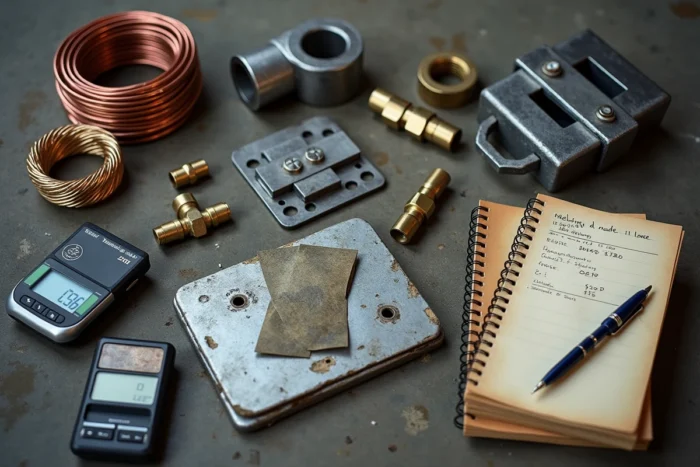
Negotiating at Derichebourg: what works and what is useless
Unlike a local depot where the owner sometimes sets the price based on the customer’s appearance, Derichebourg agencies operate on a grid. The margin for negotiation mainly lies in the classification of the lot, not on the price.
If the operator classifies your copper as “mixed” when it is clean and sorted, request a reclassification. Show that you have separated the qualities. On large volumes (starting from a few hundred kilos), some agencies accept to set a price slightly above the standard grid, especially if you bring in regularly.
What does not work: mentioning a competitor’s price without proof, or arriving with an unsorted lot hoping for a premium rate. The recycler sees dozens of loads every day; they assess quality in seconds.
Selling your metals at the right time: following prices without becoming a trader
Monitoring the price of copper or aluminum every morning is not very useful if you sell twenty kilos once a year. However, if you accumulate metals regularly, storing for a few weeks during a rising trend can make a real difference.
Several specialized sites publish daily prices for ferrous and non-ferrous metals. La Tribune des Métaux or public stock platforms allow you to spot seasonal cycles. Industrial demand tends to increase at the beginning of the year and at the end of the third quarter, which generally drives prices up during these periods.
Storing for too long carries a risk: prices can drop as quickly as they rise. A good compromise is to set a floor price below which you do not sell, and to sell as soon as the price goes above.
The final price always depends on the combination of the current price, sorting quality, and volume. Mastering the last two parameters remains the most reliable way to obtain a better rate, regardless of the timing of the sale.