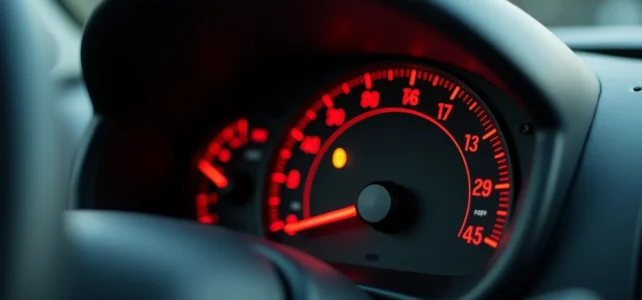
On a Renault Twingo with a combustion engine, the reserve light comes on when there is about 10% of the tank left. This technical data, common to most modern vehicles, does not say much about the actual distance that remains to be traveled. The answer depends on the generation of Twingo, its engine type, and the driving conditions at the moment the orange light appears on the dashboard.
Fuel tank and reserve: differences by Twingo generation
Articles discussing the fuel reserve on Twingo almost systematically forget to specify which Twingo they are referring to. A Twingo 1 equipped with the 1.2 8V, a Twingo 2 with the 1.2 16V, and a Twingo 3 with the SCe or TCe engine do not have the same tank or the same consumption levels.
The tank capacity has evolved from one generation to another. The volume of fuel remaining when the light comes on also varies, even if the principle remains the same: the light activates when the gauge detects a low threshold, generally around 10% of the total capacity.
To know precisely how many kilometers with the fuel reserve on Twingo, you need to cross this residual volume with the actual fuel consumption of the engine. On a Twingo 3, user feedback places this residual autonomy between 50 and 80 km in normal driving, sometimes more on open roads at moderate speeds.
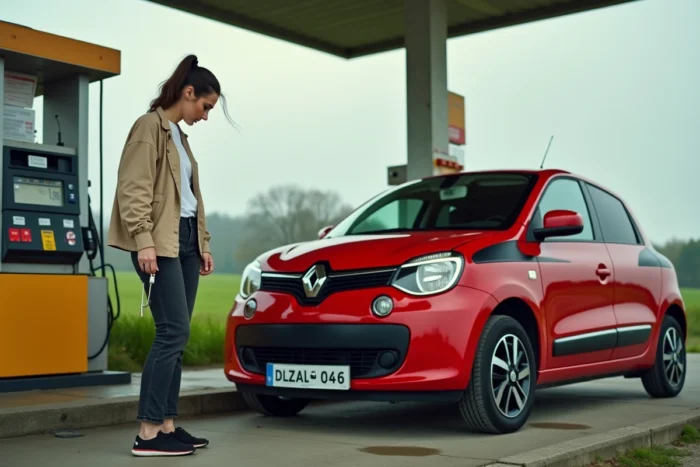
Actual consumption of a Twingo: the factor that changes everything
The standardized consumption displayed by the manufacturer serves as a reference, but it does not reflect daily conditions. In the city, with frequent stops, restarts, and air conditioning, actual consumption increases significantly compared to the catalog figures.
Several parameters affect the distance that can be traveled on reserve:
- Average speed: driving at 90 km/h consumes significantly less than driving at 130 km/h on the highway, where aerodynamic resistance increases exponentially.
- Driving style: aggressive accelerations and late braking markedly increase consumption compared to anticipatory and smooth driving.
- Vehicle maintenance condition: a clogged air filter, worn spark plugs, or under-inflated tires increase fuel costs.
- Loading: a full trunk or several passengers put more demand on the engine, especially in a small vehicle like the Twingo.
On a Twingo 3 SCe in dense urban areas, actual consumption often exceeds the announced values. The reserve then depletes faster than expected, and the theoretical 80 km can shrink to 50 km or even less in traffic jams.
Twingo electric E-Tech: a reserve that works differently
With the arrival of the Twingo E-Tech electric, the notion of reserve changes radically. There is no longer a gasoline tank or a classic orange light. The reserve corresponds to the last percentages of battery, managed by the BMS (Battery Management System) which protects the cells from deep discharge.
Press tests show that in gentle driving, the Twingo E-Tech displays a consumption of about 10 to 13.5 kWh/100 km, allowing for a range of 200 to 220 km on a full charge. On the highway or in cold weather, this range drops significantly.
The comparison with the combustion version stops there. On the electric version, the dashboard displays a battery percentage and a distance estimate that recalculates in real-time. Driving on the last percentages exposes the battery to accelerated degradation, whereas emptying a gasoline tank mainly poses a temporary mechanical risk (fuel pump, injectors).
Mechanical risks of regularly driving on fuel reserve
Consistently delaying refueling is not trivial for the mechanics of a combustion Twingo. The fuel pump, submerged in the tank, uses gasoline as a cooling liquid. When the level drops too low, the pump runs partially dry and overheats.
The sediments present at the bottom of the tank pose another problem. Under normal operation, they remain at the bottom without being sucked up. When the fuel level is very low, the pump draws these impurities towards the filter and injectors. On an aging vehicle, this phenomenon accelerates wear on the fuel system.
Concrete consequences on the Twingo
A repeated dry tank situation on a Twingo can lead to premature replacement of the fuel pump, a part whose cost and labor are not negligible in this vehicle segment. The fuel filter also clogs more quickly, degrading engine performance and increasing consumption.
On injection engines, running with too little fuel can cause misfires. The engine control unit detects these anomalies and may switch to limp mode, limiting available power.
Estimating your actual margin: simple and reliable calculation
To assess the remaining distance when the light comes on, a simple method works for all generations of Twingo. Record your average consumption displayed by the onboard computer (or calculated manually at the fill-up). Then divide the estimated volume of the reserve by this consumption.
If the onboard computer indicates a consumption of 6 liters per 100 km and the reserve contains about 5 liters, the calculation gives: (5 / 6) x 100 = about 83 km. Apply a safety margin of at least 20% to account for unforeseen circumstances (unexpected traffic jam, detour, uphill).
This calculation remains an estimate. The fuel gauge of a Twingo, like that of most city cars, is not a precision instrument. It uses a float whose reading can vary depending on the vehicle’s tilt or the wear of the sensor. It is better to consider the reserve light as a signal for a soon-to-be stop rather than the start of an endurance challenge.