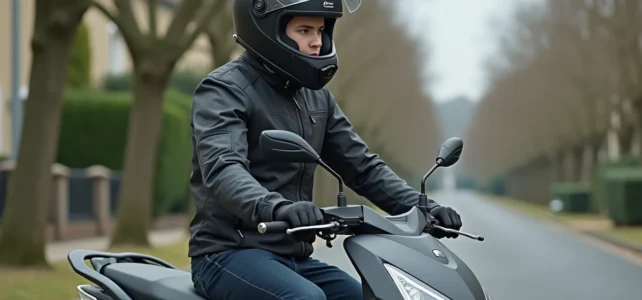
The French regulations distinguish scooters based on their engine capacity, electric power, and maximum design speed. These three parameters determine the required license, the minimum age of the driver, and the equipment obligations. Even before discussing license categories, it is this technical classification that sets the applicable legal framework.
Engine Capacity, Power, and Speed: The Framework Before the License
Discussions often focus on the distinction between 50 cm³ and 125 cm³, but the truly structuring criterion is the maximum speed by design. A moped (category L1e) must not exceed 45 km/h by design. Beyond this threshold, the vehicle falls into the category of light motorcycles, with stricter regulations.
For electric scooters, the logic is the same: the motor power replaces engine capacity as the classification indicator. An electric scooter limited to 45 km/h and with a power not exceeding 4 kW is considered equivalent to a 50 cm³ gasoline scooter. Beyond that, it falls under the A1 or A2 license depending on its nominal power.
This distinction has direct consequences for those wishing to check the requirements for riding a scooter before making a purchase: the same chassis may require two different licenses depending on the version (restricted or not) offered by the manufacturer.
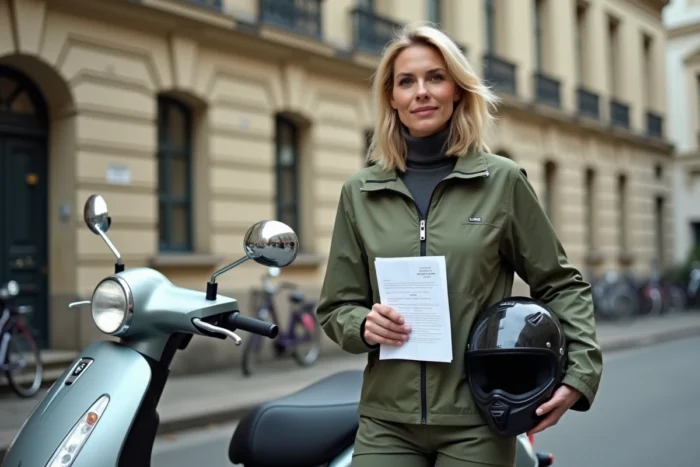
AM, A1, A2 Licenses: Which Title for Which Scooter in France
The AM license (formerly known as BSR) applies to mopeds with an engine capacity not exceeding 50 cm³ or with electric power below 4 kW. It is accessible from the age of 14, after completing practical and theoretical training provided by a driving school.
To obtain the AM license, three conditions must be met:
- Having validated the school road safety certificate (ASSR level 1 or 2) or the road safety certificate (ASR) for those not in school
- Completing a minimum of eight hours of practical training, spread over at least two days
- Being at least 14 years old at the time of the license issuance
Individuals born before 1988 are exempt from any license to drive a 50 cm³, provided they have not had their license revoked or suspended.
125 cm³ Scooters and the A1 License
The A1 license allows the operation of light motorcycles with an engine capacity not exceeding 125 cm³ and a power of no more than 11 kW (15 horsepower). The minimum age is set at 16 years. The training includes a theoretical exam (the motorcycle code) and a practical test on a closed course followed by on-road driving.
Holders of a B license for more than two years can access 125 cm³ scooters by completing a seven-hour training course, often referred to as “125 bridge.” This training does not grant the A1 license, but provides an equivalence limited to French territory.
Beyond 125 cm³: A2 License Then A
Scooters with a power exceeding 11 kW but not exceeding 35 kW fall under the A2 license, which is accessible from the age of 18. After holding the A2 for two years and completing an additional seven-hour training, the driver can obtain the A license, which removes all power restrictions.
Three-Wheeled Scooters: A Special Regulatory Case
Three-wheeled scooters (like the Piaggio MP3 or Peugeot Metropolis) often represent a blind spot in understanding the regulations. Their classification depends on the wheel spacing and the vehicle’s power.
A three-wheeler in category L5e with power exceeding 15 kW can be driven with a B license, provided the driver is at least 21 years old and has held their license for more than two years. No additional training is required, unlike what is required for a 125 cm³ two-wheeler.
On the other hand, lower-powered three-wheelers follow the same rules as their equivalent two-wheelers: AM license for models limited to 45 km/h, A1 license for those not exceeding 125 cm³ and 15 horsepower.
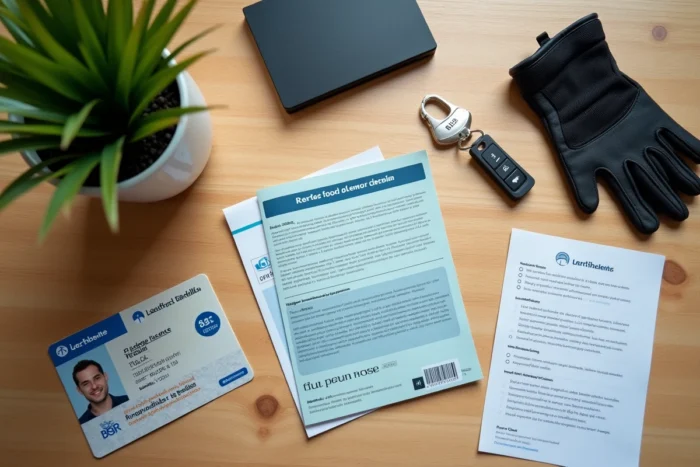
Insurance and Homologation: Often Overlooked Obligations
The issue of the license often overshadows another equally binding aspect: the obligation of insurance and vehicle compliance. Any scooter operating on public roads must be covered by at least third-party liability insurance, including low-power electric models.
Inspections have intensified in recent years, particularly on electric scooters sold online without a European compliance certificate. A vehicle lacking this homologation cannot be registered, and driving without registration exposes one to a fixed fine as well as impoundment.
The points to check before putting the vehicle on the road are as follows:
- Presence of the certificate of conformity (COC) issued by the manufacturer or an individual type approval (RTI) for imported vehicles
- Subscription to an insurance policy covering at least third-party liability
- Obtaining the registration certificate (carte grise) from the ANTS or an authorized professional
- Wearing an ECE 22.05 or 22.06 certified helmet, mandatory for both the driver and passenger
Driver Size and Ergonomics: What the Law Does Not Specify
No French regulatory text sets a minimum height for riding a scooter. The law imposes an age, a license, and insurance, but not a morphological criterion. Therefore, the question of height falls under practical safety, not legal requirements.
A driver who cannot place their feet flat on the ground when stopped takes a real risk of losing balance, especially at low speeds or during maneuvers in the city. Seat height varies significantly between models: some urban scooters have heights below 750 mm, while others exceed 800 mm.
The choice of model is as important as the license for safe riding. Manufacturers offer lowered seats or adjustable suspensions on certain ranges, but these options remain rare on entry-level 50 cm³ scooters. Testing the scooter before purchase, in real traffic conditions, remains the only reliable method to assess the fit between the driver’s morphology and the vehicle.
French regulations strictly govern licenses, insurance, and homologation, but leave the responsibility of choosing a vehicle suited to one’s morphology to the driver. A perfectly legal scooter can become dangerous if the driver does not master the ground support. Checking seat height and testing the vehicle before purchase is as protective as a good insurance contract.