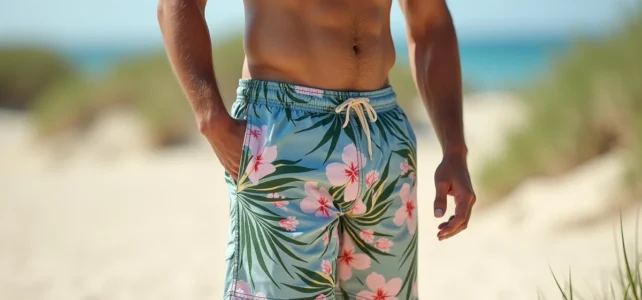
The inner mesh is the most reliable marker of swim shorts. This mesh lining, sewn directly into the crotch, distinguishes a true pair of swim shorts from city shorts, surf boardshorts, or sports shorts. Before folding anything into a beach bag, turn the shorts inside out and check for this lining; it cuts the question in two seconds.
Mesh lining and internal construction of swim shorts
The mesh lining (air-permeable mesh, usually made of polyester) serves three technical functions: support, hygiene, and quick drying. It eliminates the need for additional underwear and prevents the outer fabric from sticking to the skin after immersion. A pair of shorts without mesh lining is not swim shorts, even if it looks exactly like a swimwear model.
The boardshort, designed for surfing, does not include this mesh. It is worn with technical underwear or a rashguard underneath, and its cut falls below the knee to protect against board chafing. A city short made of cotton or linen obviously has no lining either, and its fabric absorbs water instead of wicking it away.
It is also useful to check the stitching of the mesh: on a properly assembled pair of swim shorts, the lining is sewn all around the waistband and not just glued or fixed at one point. This detail distinguishes durable models from entry-level products that lose their mesh after a few washes.
A complete guide to identifying these manufacturing clues is available on the CC Rhin website, which details the recognition criteria point by point.
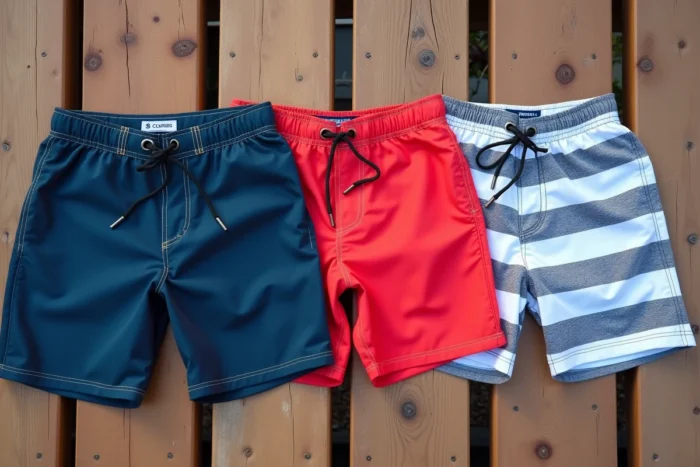
Textile material: polyester, polyamide, or fabric unsuitable for water
The material of the outer fabric immediately reveals the purpose of the shorts. Swim shorts almost always use polyester or polyamide (nylon), two synthetic fibers that dry quickly, resist salt and chlorine, and do not deform when wet.
Shorts made of cotton, linen, or viscose are not made for water. Cotton absorbs several times its weight in water, takes hours to dry, and weighs down the garment to the point of hindering swimming. Linen wrinkles and stretches. Viscose loses its shape as soon as it gets soaked.
Identifying the composition on the label
The composition label remains the quickest test in-store. A pair of swim shorts displays a predominantly synthetic composition, often accompanied by a small percentage of elastane for comfort. Here are the clues to look for:
- Polyester or polyamide making up more than 80% of the composition, sometimes complemented by elastane (stretch)
- Mention of “quick drying” on the label or packaging
- Absence of cotton, linen, or viscose in the main composition
If the label predominantly indicates cotton, the shorts are suitable for the terrace or a walk, not for swimming.
Drawstring and elastic waistband: what the waistband says
The waistband of swim shorts almost always combines an integrated elastic and a drawstring with eyelets. This dual fastening allows for adjustment once the fabric is wet, as a waterlogged pair of shorts weighs more and pulls down.
City shorts typically use a rigid waistband with a button, zip fly, or belt loops. Some hybrid shorts (worn in the city as well as at the beach) adopt a mixed system with a zip and drawstring, but the presence of a button-only fly, without a drawstring or elastic, indicates a garment not intended for swimming.
The case of hybrid city-beach shorts
For a few seasons now, brands have been offering shorts with an urban look but featuring a mesh lining and synthetic fabric. They are recognizable by their more fitted cut, without large tropical patterns, often with a drawstring hidden inside the waistband. A short, solid-colored, with an inner mesh and hidden drawstring is a pair of swim shorts, even if it resembles a shortened chino.
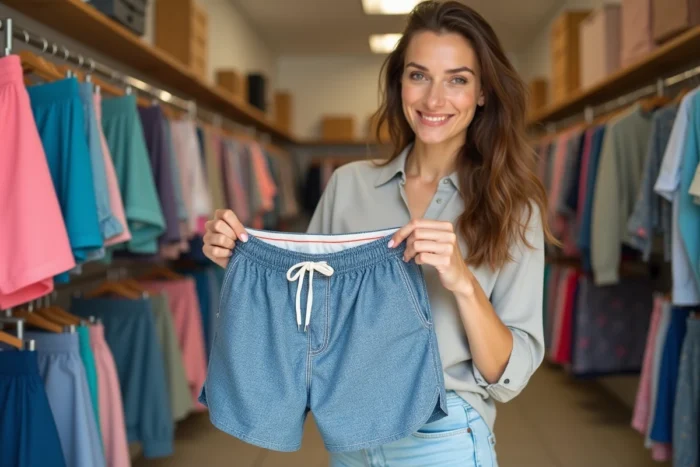
Boardshorts, sports shorts, swim shorts: common confusions
The most common confusion is between boardshorts and classic swim shorts. Boardshorts fall to the knee or below, use a hook-and-loop or flat lace closure, and do not have an inner mesh. They are designed for surfing and gliding, not for swimming.
Sports shorts (running, fitness) share with swim shorts their synthetic material and quick drying. Three elements differentiate them:
- Sports shorts do not have a mesh lining like swimwear, but sometimes have an integrated compression short
- Their fabric is often thinner, lighter, and perforated (micro-ventilation), whereas swim shorts use a denser weave to withstand abrasion from sand and salt
- Sports shorts rarely have a drawstring with eyelets, preferring a simple wide elastic
Turning the shorts inside out and looking for the mesh remains the quickest gesture to distinguish between these three categories.
Local regulations and pool access: a often overlooked criterion
In France, most municipal pools refuse swim shorts in favor of fitted swimsuits (briefs, boxers, jammers). Swim shorts, even with mesh, are considered potential city clothing and therefore unhygienic according to the internal regulations of many establishments.
Conversely, some coastal municipalities prohibit walking in the city center in swimwear or swim shorts, considered inappropriate beach attire for public spaces. Knowing how to identify swim shorts avoids access refusals in both directions: pool and city center.
The modesty over-short, worn over a swimsuit for religious or personal reasons, adds a layer of confusion. This garment resembles swim shorts but does not replace them: it has neither mesh lining nor technical fabric, and its function is to cover, not to swim.
Before heading to the beach or pool, turning the shorts inside out, reading the composition label, and checking the waistband system is enough to eliminate any ambiguity. These three gestures take less than ten seconds and prevent you from ending up soaked in a garment that was never intended for water.