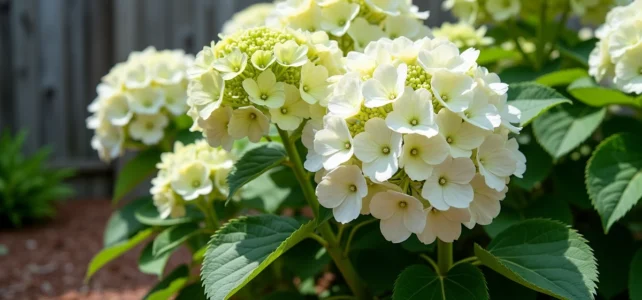
We replant a white hydrangea in April, admire its immaculate blooms in June, and by mid-July the inflorescences turn to apple green. This scene repeats every summer in thousands of gardens. The common reflex of changing fertilizer or altering watering randomly often exacerbates the problem. Understanding the mechanism behind this greening allows for intervention at the right time, with the right action.
Thermal stress and closed stomata: greening accelerated by heat
Most articles on the color change of hydrangeas discuss soil pH. This is relevant for the pink-blue shift of macrophylla, but it does not explain why a white hydrangea turns green. In the field, it is observed that this greening accelerates significantly during episodes of intense heat.
Beyond about 30 °C, the hydrangea enters survival mode. It closes its stomata to limit water loss, which reduces sap circulation in the inflorescences. The white pigments, already fragile, degrade faster, and chlorophyll takes over in the sepals. The result: flowers that green in just a few days instead of remaining white for several weeks.
There are solutions for a white hydrangea turning green by acting on the immediate environment of the plant, but it is essential first to identify if heat is indeed the main trigger.
A common trap: watering a heat-stressed hydrangea in full sun. Cold water on hot soil causes thermal shock at the roots. The flowers brown or green even faster. Watering in the evening, at the base, never on the foliage remains the most effective rule to limit damage.
Natural flowering cycle: when green is normal
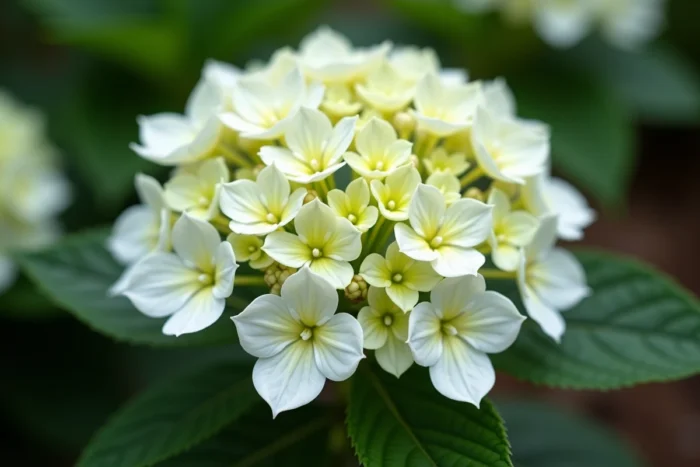
Not all hydrangea flowers are true petals. What we call a “flower” is actually a sepal, a modified leaf. And like any leaf, it contains chlorophyll.
At the beginning of flowering, pigments (anthocyanins for pinks and blues, absence of pigment for whites) mask the green. At the end of the cycle, these pigments naturally degrade. The greening at the end of summer is a normal physiological process, not a disease.
On a white Hydrangea macrophylla, this shift generally occurs after several weeks of flowering. If your flowers have remained white from June to early August before turning green, there is probably nothing to correct. The shrub is simply following its genetic program.
The problem arises when greening appears very early, within the first few weeks of flowering. This is a sign of stress (heat, lack of indirect light, excess nitrogen) that needs to be identified.
Excess nitrogen in the soil and early greening of hydrangeas
Soil that is too rich in nitrogen pushes the plant to produce excess chlorophyll, including in the sepals. This is often seen in gardens where a lawn fertilizer has been spread nearby, or very young compost rich in undecomposed organic matter.
The signs are recognizable:
- The leaves are a very dark green, almost shiny, with vigorous vegetative growth
- The inflorescences green early in the season while flowering has just begun
- The plant produces a lot of foliage but the flowers remain small or few in number
Reducing or stopping nitrogen fertilizer application is usually enough to achieve whiter inflorescences the following season. A fertilizer for acid-loving plants, balanced in potash and phosphorus, which promotes flowering without pushing foliage, is preferred.
White hydrangea varieties more stable in color
Feedback on this point varies by region and exposure, but some varieties retain their white much better than others. The choice of cultivar makes a real difference.
Hydrangea paniculata (such as ‘Limelight’ or ‘Vanilla Fraise’) and Hydrangea arborescens (such as ‘Annabelle’) are much less sensitive to soil pH than classic macrophylla. Their white color remains stable longer, even in heat conditions.
Among the new varieties, “Storm Proof” cultivars in arborescens show improved flower retention. These recent selections have been designed to withstand heat episodes without the inflorescences collapsing or greening prematurely.
Here are the criteria to check before choosing a white hydrangea:
- The botanical type (paniculata and arborescens are more stable than macrophylla in white)
- The announced heat resistance, especially if your garden is south-facing
- The flowering duration indicated by the nursery, which gives an idea of color retention
- The sturdiness of the stems, as varieties with strong stems better withstand bad weather without discoloration
Concrete actions to limit greening in the garden
Rather than a list of generic advice, let’s focus on the three interventions that truly change the outcome.
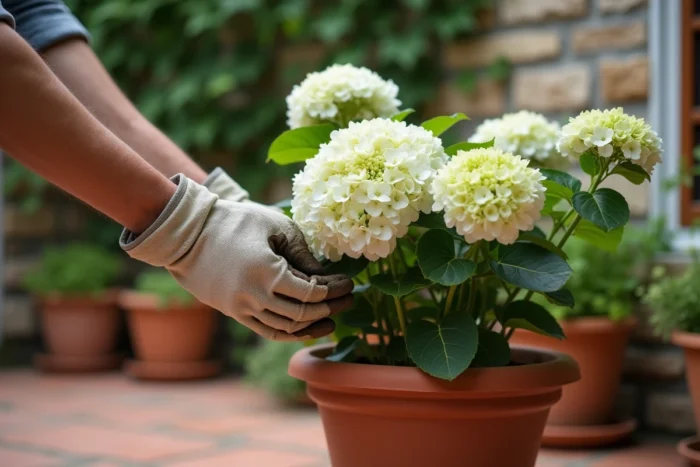
Thick mulching at the base
An organic mulch (pine bark, dead leaves, straw) keeps the soil cool and limits thermal shocks to the roots. A mulch several centimeters thick significantly reduces soil temperature during heat spikes. This is the action with the best effort-to-result ratio.
Shade during critical hours
The white hydrangea can tolerate morning sun, but direct sunlight from noon to 4 PM accelerates the degradation of the sepals. A temporary shade cloth or planting under a lightly foliaged tree protects the inflorescences during the hottest days.
Pruning faded flowers at the right time
Removing inflorescences as soon as they start to green prevents the plant from wasting energy. Cutting just above the first pair of well-formed buds allows resources to be concentrated on the still-white flowers or on preparing for the next flowering.
The greening of a white hydrangea is not always a problem to solve. At the end of the season, it is the plant’s normal cycle. In the height of summer, it is a signal of thermal stress, excess nitrogen, or a cultivar poorly suited to the exposure. Identifying the exact cause before acting remains the only approach that yields lasting results from one season to the next.