A parent who forgets their medication three days in a row. A mother who no longer answers the landline because the ringtone no longer reaches her from the garden. These mundane situations reveal a specific need: to adapt the daily environment of seniors to their real constraints, not to an abstract age category.
Conversational AI in Alzheimer’s units: when personalization changes care
In several French nursing homes, psycho-geriatric teams are testing voice assistants configured based on the personal history of Alzheimer’s residents. The principle: family members and caregivers provide biographical markers (hobbies, happy events, lifestyle habits) so that the AI can propose soothing conversations drawn from the resident’s experiences.
The goal is not to replace human connection. The aim is to reduce agitation during tense phases, particularly in the evening, and to limit the systematic use of medication. Feedback on this point varies according to cognitive profiles, but the framework is promising because it relies on co-construction between relatives and professionals.
This type of approach illustrates well what Your Health Assistant’s senior solutions offer, where technology adjusts to individual needs rather than imposing a generic tool.
Connected objects for home care: choosing based on real needs

The market for connected objects aimed at seniors is vast, and there is a temptation to equip a home with all kinds of sensors. In practice, it is better to focus on two or three devices that address an identified problem rather than piling on gadgets.
Connected pillbox and treatment monitoring
A connected pillbox sends an alert to the caregiver if medication has not been taken at the scheduled time. For a senior on chronic medication, this is often the first truly useful connected object. The device is simple, non-intrusive, and provides precise information remotely.
Fall sensors and motion detectors
Sensors placed on the floor or integrated into a bracelet detect a fall and send an alert to a teleassistance center or directly to a relative. Their effectiveness depends on the installation: a poorly positioned sensor in a narrow hallway generates false positives that end up being ignored.
Before installing anything, it is recommended to list the risky areas (bathroom, stairs, kitchen) and focus the devices there. Fewer sensors, better placed, yield better results than a poorly calibrated complete network.
Concrete selection criteria
- The ease of recharging or replacing batteries: a connected object that is off protects no one
- Compatibility with the teleassistance service already in place for the senior
- The sound level and readability of alerts, adapted to potential hearing or visual impairments
- The ability for the caregiver to receive notifications on their own phone, without a complex app
Cognitive stimulation at home: beyond mainstream applications
Brain training apps are abundant, but their impact on the cognitive health of seniors remains debated. What makes the difference is the regularity of use and adaptation to the person’s actual level.
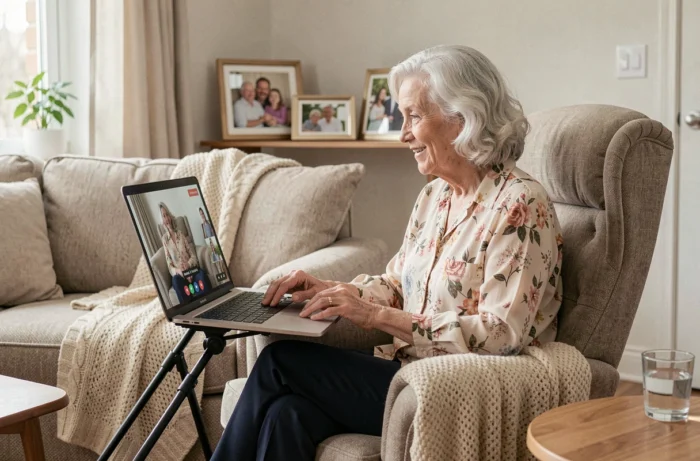
Some organizations combine a touchscreen tablet with monitoring by a professional (speech therapist, psychologist) who adjusts exercises based on observed progress or difficulties. This feedback loop transforms a simple game into a structured cognitive stimulation tool.
Virtual reality is also beginning to be used in socio-medical contexts. Workshops offer seniors immersive experiences (visiting familiar places, walking in the woods) to stimulate memory and reduce feelings of isolation. The device remains costly for individual home use, but it works well in group sessions, in nursing homes or day care centers.
Teleassistance and caregiver coordination: the often underestimated link
There is much talk of connected objects and technological innovation, but the coordination between family caregivers and professionals remains the weak point of most home care devices. An alert bracelet is useless if no one knows who should intervene first.
Recent teleassistance platforms now integrate a shared digital logbook between the primary caregiver, the family doctor, and home care providers (housekeeper, nurse). Each visit is recorded, and each observation is shared.
- The senior has a human contact reachable at any time, not just an algorithm
- The family caregiver receives a daily or weekly summary, according to their preferences
- The doctor accesses follow-up data (medication intake, physical activity, alerts) to adjust care during consultations
This approach works because it relies on coordinated services around the senior, not on a pile of disconnected tools.
The Idéa’Dom call for projects, relaunched in 2026 by Agirc-Arrco and Silver Valley, specifically targets this type of solution: innovations that demonstrate a clear social benefit and the ability to be deployed across different territories. The replicability criterion encourages project leaders to design adaptable devices, not laboratory prototypes.
Improving the daily life of a senior does not rely on the latest technology but on that which addresses their most frequent constraint. A well-configured connected pillbox, a properly installed fall sensor in the bathroom, a shared logbook among caregivers: these simple building blocks, assembled around an identified need, produce more tangible results than a spectacular piece of equipment left in a drawer after three weeks.