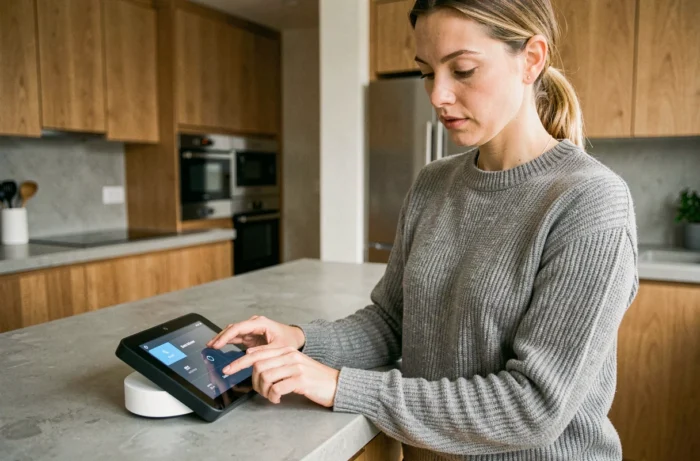
Turn on the living room light from the couch, lower the heating when leaving for work, or check who is at the door from your phone: these everyday actions rely on simple equipment that is easy to install, even without technical knowledge. Making your home smart and connected doesn’t require a complete overhaul all at once. A few well-chosen devices are enough to transform your comfort, security, and energy consumption.
Communication Protocols: The Invisible Foundation of the Connected Home
Before purchasing any connected device, a technical question deserves your attention. How will your devices communicate with each other? This is the role of the communication protocol.
Three families dominate the market. Wi-Fi, which you are already using, is suitable for cameras and speakers. Zigbee and Z-Wave, which are less energy-hungry, are designed for sensors, bulbs, and detectors. They require a small central hub, often referred to as a gateway or home automation box, which links all your connected objects.
You may have heard of Matter. This recent protocol aims to solve a common problem: incompatibility between brands. A thermostat from one manufacturer, a bulb from another, a voice assistant from a third, and nothing works together. With Matter, devices from different brands communicate without complex configuration. If you’re just starting out, prioritizing Matter-compatible products significantly simplifies setup.
To explore the various technologies and equipment available in home automation, a useful resource is: https://www.domotica.fr/.
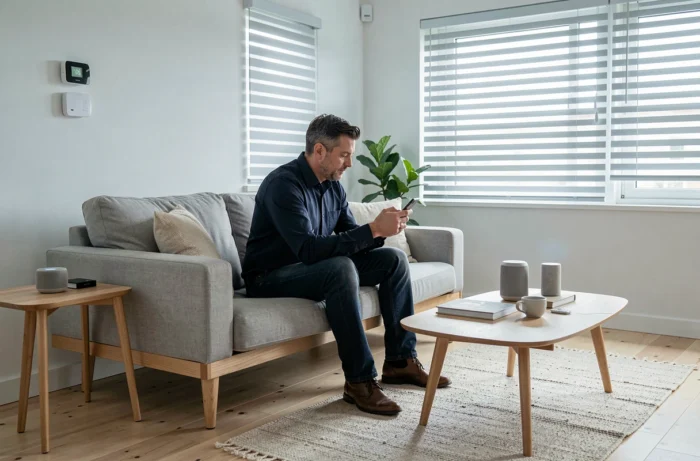
Connected Lighting and Heating: The First Devices to Install
Where to start when you want to make your home smart? Two areas offer immediate results: lighting and heating.
Smart Bulbs and Lighting
A connected bulb screws in like any other bulb. It is then controlled from an app on your smartphone or by voice via a voice assistant. You can schedule it to turn on at sunset, adjust the brightness according to the time, or simulate presence when you’re on vacation.
The entry cost remains modest. Two or three smart bulbs in the living areas are enough to notice the difference. There’s no need to replace the entire electrical installation.
Connected Thermostats and Thermostatic Heads
Heating represents the largest energy expenditure in most homes. A connected thermostat learns your habits and adjusts the temperature room by room. You can lower the heating remotely when you leave the house, and it will rise again before your return.
Connected thermostatic heads, installed on each radiator, offer even finer control. They allow you to heat only the occupied rooms, which reduces energy consumption without sacrificing comfort.
- Central connected thermostat: controls the entire heating system from a single interface, ideal for collective heating or an individual boiler.
- Connected thermostatic heads: room-by-room regulation, suitable for hot water radiators.
- Time programming and geolocation: the heating automatically adapts to your schedule and geographical location.
Connected Security: Cameras, Detectors, and Smart Locks
Security is often the main motivation for transitioning to a connected home. Current systems no longer resemble the wired alarms of ten years ago.
A connected surveillance camera sends a notification to your phone as soon as it detects movement. You can see in real-time what is happening at home, wherever you are. Some models operate without a monthly subscription, storing videos locally on a memory card.
Open/close detectors, placed on doors and windows, complement the system. Coupled with a connected siren, they form a modular alarm system that you can gradually expand.
Smart locks allow you to lock or unlock your door remotely. This is convenient when a delivery person needs access to your entry or when you grant temporary access to someone close. Most are installed over the existing lock, without replacing the cylinder or modifying the door.
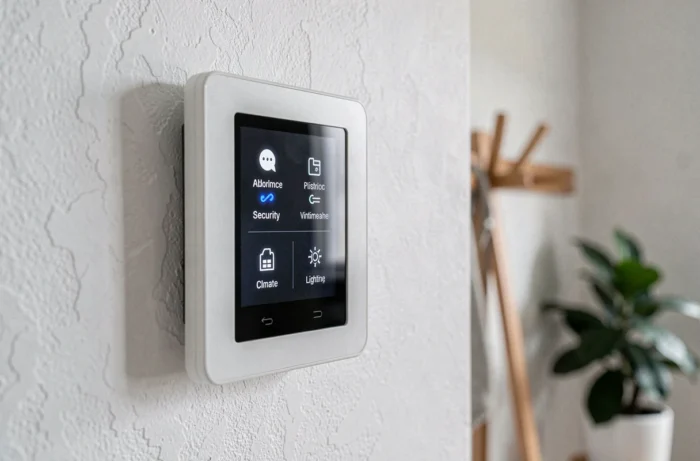
European Data Act: What Changes for Your Connected Devices in 2026
You buy a connected thermostat, and all its data remains locked in the manufacturer’s app. It’s impossible to export it to another software or analyze it freely. This situation is about to change.
Starting September 12, 2026, the European Data Act requires that every new connected product launched on the EU market makes its data accessible to the user. In practical terms, your thermostats, cameras, motorized shutters, or connected appliances will need to provide your data in a structured format that can be read by other systems.
This so-called “data by default” design requirement means you will be able to retrieve your heating consumption data and transmit it to a third-party home automation app or an energy optimization service. Data sharing obligations with the user have been in effect since September 2025, but the switch applies to products designed after September 2026.
Why is this a purchase criterion? Because a device compliant with the Data Act ensures you won’t be trapped in a closed ecosystem. Check Data Act compatibility before investing in new home automation equipment.
Building Your Home Automation System Without Getting Distracted
The temptation to accumulate connected objects is great. A smoke detector here, a connected plug there, a voice assistant in every room. The result is often a disjointed collection, with three different apps to control six devices.
A more effective approach is to choose a primary ecosystem (a voice assistant or a home automation box) and stick to it for the initial devices. You can then add new compatible devices over time.
- Start with a concrete need: reduce the heating bill, secure the entrance, or automate the lighting.
- Choose devices compatible with the same protocol (Matter, Zigbee, or Z-Wave) to ensure interoperability.
- Add one or two connected devices per quarter rather than all at once, to master each step.
The most effective smart home is not the one with the most connected devices. It’s the one where each device serves a specific purpose and communicates with others seamlessly. Three well-integrated devices are worth more than ten isolated gadgets.