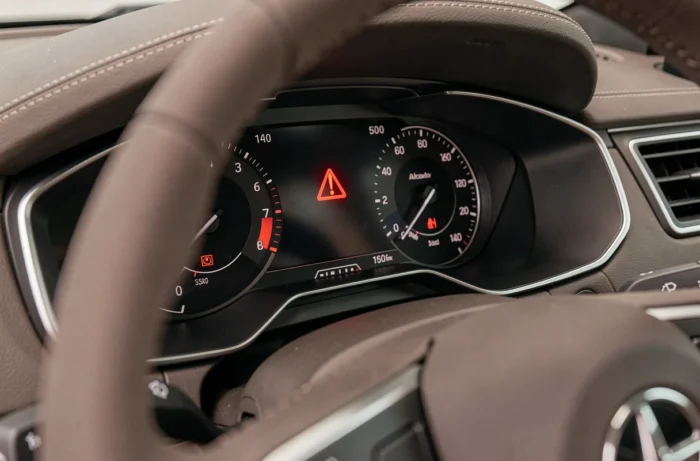
The red triangle with an exclamation point that lights up on a car’s dashboard often generates immediate concern. This warning light does not indicate a single malfunction: it encompasses several critical alerts related to braking, electronics, or other vehicle systems. Understanding what it signals, and especially what differentiates it from an orange warning light, allows for an appropriate response.
Red triangle or orange triangle: two distinct levels of alert on the dashboard
The color of the triangle warning light with an exclamation point radically changes the severity of the message. Both versions coexist on most recent vehicles, but they do not elicit the same reaction.
| Criteria | Red Triangle | Orange Triangle |
|---|---|---|
| Urgency Level | Critical, stop recommended | Non-critical, caution required |
| Concerned Systems | Braking, hydraulic circuit, major failure | Driving assistance, tire pressure, lighting, fluid level |
| Possible Driving | No, except to get to safety | Yes, with caution and quick control |
| Immediate Action | Stop as soon as possible, call for assistance | Check the onboard message, consult the manual |
An orange warning light calls for caution without requiring an immediate stop. It may appear at startup for a self-test, then turn off after a few seconds. A red triangle requires the vehicle to stop as soon as possible.
To delve deeper into the meaning of the red triangle car logo, several scenarios deserve to be detailed according to the system involved.

Red triangle warning light and braking system: the most common cause
In most cases, the red triangle with an exclamation point is directly related to the braking circuit. Three situations frequently arise.
Handbrake still engaged
The simplest and most common cause. If the warning light comes on as soon as you start, first check that the parking brake is fully released. On some models equipped with an electric handbrake, a slight misalignment in the sensor can trigger the alert.
Insufficient brake fluid level
A low brake fluid level directly compromises braking ability. The sensor located on the brake fluid reservoir detects the drop and activates the red warning light. This situation can result from a leak in the hydraulic circuit or simply from wear on the brake pads, which mechanically lowers the level in the reservoir.
Braking circuit failure
When the problem does not stem from the handbrake or the fluid level, the warning light may indicate a deeper anomaly in the circuit. This includes a failing master cylinder, a punctured hose, or a malfunctioning ABS sensor. Any loss of pressure in the braking circuit makes the vehicle dangerous.
Red triangle warning light outside of braking: other concerned systems
The red triangle with an exclamation point is not limited to braking. Depending on the manufacturer and model, this warning light also serves as a general alert for failures that require a quick stop.
- Engine overheating detected by the computer, especially when the temperature light does not have its own dedicated indicator on the dashboard
- Abnormally low engine oil pressure, which can cause mechanical damage within minutes of driving
- Failure of the electric power steering system, making the steering wheel very hard to maneuver
- Major electronic anomaly reported by the vehicle’s main computer
The exact meaning depends on the manufacturer. On some vehicles, the red triangle is accompanied by a text message on the dashboard screen that specifies the nature of the problem. On others, it is necessary to consult the owner’s manual to cross-reference the warning light with any potential error codes.

What to do when the red triangle warning light comes on while driving
The reaction should be proportional to the context in which the warning light appears. A red triangle that appears while driving at high speed should not be handled the same way as a warning light that comes on at startup in a parking lot.
If the warning light comes on while in traffic, gradually reduce your speed and head to a safe location. Do not brake suddenly until you have assessed whether the braking responds normally. If the brake pedal feels soft or sinks abnormally, use engine braking by downshifting and the handbrake as a last resort to stop the vehicle.
Once stopped, turn off the engine and restart after a few seconds. If the warning light persists, do not return to the road. Call for assistance or a tow truck.
Faulty sensor or real mechanical problem
A faulty sensor can trigger the red warning light without there being a real failure in the braking system or engine. The problem is that it is impossible to distinguish a false alert from a real malfunction without diagnostic tools. Treating every illumination of the red triangle as a real emergency remains the only prudent approach.
A visit to a mechanic equipped with a diagnostic tool allows for reading the error codes recorded by the computer. The cost of a diagnostic remains minimal compared to the consequences of ignoring a faulty braking system.
Red triangle and technical inspection: a warning light that can lead to a re-inspection
A red warning light illuminated on the dashboard is one of the points checked during the technical inspection. If the red triangle with an exclamation point remains active after the vehicle has started, the inspector may note a major defect and impose a re-inspection.
Failures in the braking system are among the most common reasons for re-inspection. Having the cause of the warning light diagnosed and repaired before presenting the vehicle for technical inspection avoids wasting time and incurring additional costs.
The red triangle with an exclamation point remains a warning light that no driver should ignore. Whether it signals a forgotten handbrake or a leak in the hydraulic circuit, the procedure is the same: stop, check, have it diagnosed. The difference between the two scenarios can only be measured with a diagnostic tool connected to the vehicle.