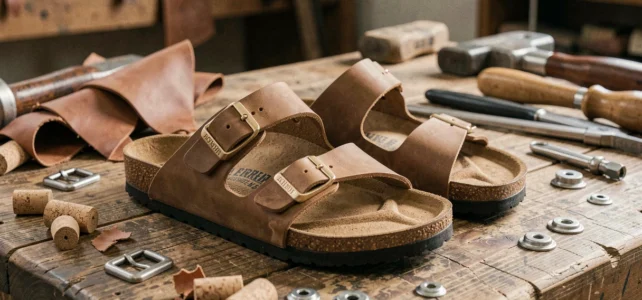
A pair of Birkenstock Arizona sandals today costs significantly more than a comparable competitor sandal in appearance. The German brand, with over 250 years of history, maintains prices that rarely decrease, even during massive sales at other retailers. The debate resurfaces every summer season: does this price reflect a true level of quality, or has Birkenstock shifted into a luxury mindset?
Birkenstock’s pricing power: what the stock market journey reveals
Since its debut on Wall Street, Birkenstock has attracted the attention of financial analysts for a specific reason: its ability to raise prices without diminishing demand. This characteristic, referred to as pricing power, is typically reserved for luxury brands like Hermès or Cartier.
In its latest published quarter, the brand recorded a sales growth of 20% excluding currency effects, surpassing groups like Hermès (9.6%) or Richemont (14%) during the same period. These figures place Birkenstock in a unique category, somewhere between high-end equipment and accessible luxury brand.
Several observers analyzing the reasons for Birkenstock’s pricing point to a circular mechanism: the relative scarcity of promotions enhances the perception of value, which in turn supports the margin, which finances the maintenance of costly European production.
However, the growth forecasts announced for the next fiscal year disappointed the markets, causing a nearly 10% drop in stock price in one session. The financial market reacts quickly when the premium pricing trajectory is not accompanied by a proportional acceleration in volumes.
European production and customs duties: the real cost of a Birkenstock
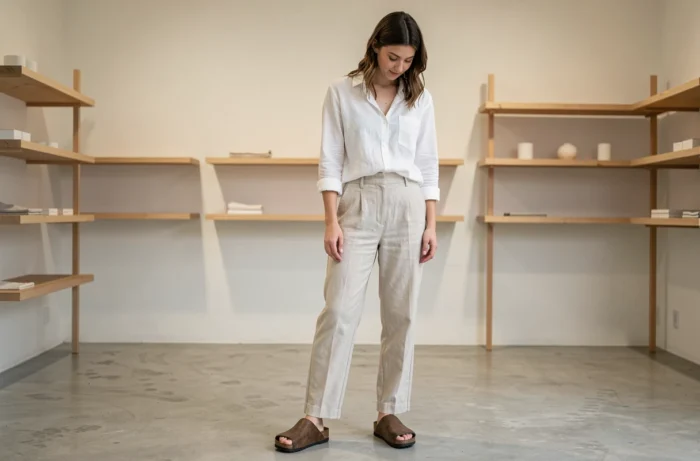
Birkenstock maintains all of its manufacturing in Germany. This choice, often presented as a guarantee of quality, has direct consequences on the price structure.
The raw materials used are not insignificant. The insole is made from natural cork, a durable and moisture-resistant material, combined with latex. The leather used in the classic models comes from selected tanneries. These natural components cost significantly more than the synthetic alternatives used by competitors.
- Cork offers shock-absorbing properties and gradually molds to the foot, which extends the perceived lifespan of the product.
- German production involves higher wages and social standards than the Asian factories where most competing sandals are made.
- The customs duties applied to European exports to the United States, a key market for Birkenstock, weigh on the final price without the consumer always being aware of it.
This last point constitutes a rarely discussed angle. The pricing pressure related to customs duties on 100% European production adds to the cost of materials and labor. For a brand that refuses to outsource, every increase in customs duties mechanically affects the price tag.
Studio 1774 and premium collaborations: the luxury strategy from the top
Birkenstock does not just sell functional sandals. The brand has developed a line called 1774, operated from a Parisian studio, which serves as a high-fashion showcase. The pieces are sold at prices several times higher than those in the standard catalog.
This strategy is not intended to generate volume. It elevates the desirability of the entire range. When a 1774 model appears in a runway show or on an influential account, it is the Arizona at €80 or €100 that benefits in terms of image.
The appearance of the sandal on Barbie’s feet in the eponymous film has amplified this phenomenon. Birkenstock has transitioned from an orthopedic object to a desirable fashion accessory in just a few years, without fundamentally altering its products. In this view, the price is no longer just a reflection of production cost: it contributes to building a status.
Copies and Birkenstock knockoffs: an indicator of positioning
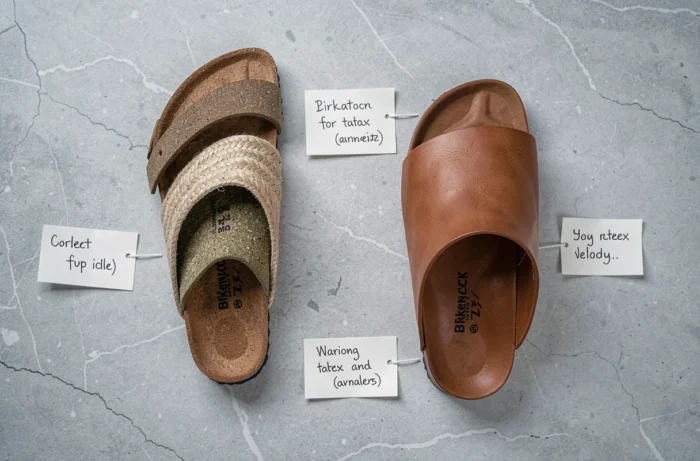
The proliferation of copies is revealing. Birkenstock faces a wave of “knockoffs” (imitations sold at reduced prices) substantial enough for the brand to engage in repeated legal actions to protect its designs.
This phenomenon says something about the brand’s actual positioning. You do not copy a purely functional product; you copy an object of desire. The imitations target the look, rarely the cork sole or the foot support system. The consumer who buys a knockoff pays for the appearance, while the one who buys the original also pays for the technical construction.
Field reports diverge on this point. Some long-time users believe that quality has slightly declined with the rising price range. Others argue that a well-maintained pair lasts several years, which brings the cost per use to a competitive level compared to sandals that are replaced every season.
Quality or luxury: a blurred boundary
The question posed in the title does not allow for a binary answer. Birkenstock combines a real technical foundation (natural materials, German manufacturing, moldable cork sole) with a brand strategy that clearly borrows from luxury codes (collaborations, rarity of promotions, stock market pricing power). The price finances both the quality of the product and the construction of a premium image.
The respective share of each component in the final price remains difficult to isolate. What is measurable is that demand does not weaken despite successive increases, and that copies do not significantly dent sales. For the consumer, the decision rests less on a rational calculation of cost per wear than on the value they assign to the whole: material, comfort, durability, and social signal.