
A rainwater collector connected to a gutter, placed on stable ground, but desperately empty in the middle of summer: the problem does not always stem from a lack of rain. Several mechanical or installation malfunctions can prevent water from reaching the tank, even after a heavy storm. Understanding the path of water between the roof and the tank allows for precise identification of where the system is failing.
Collection circuit: the path of water before the tank
Rainwater follows a specific path. It falls on the roof, flows into the gutters, descends through the downspout, passes through a filtering collector, and then enters the tank through a fitting. Each segment of this circuit can become a blockage point.
The filtering collector is the most underestimated part of the system. Attached to the downspout, it diverts water to the tank while retaining large debris. If this collector is poorly oriented, partially blocked, or improperly sized for the gutter’s flow rate, the water flows straight into the stormwater system without ever reaching the tank.
Before looking for a complex malfunction, visually check each junction of the circuit during a rain shower. A simple misalignment of a few millimeters between the collector and the inlet pipe is enough to divert the entire flow. This visual diagnosis in real conditions remains the most reliable method to identify the causes of an empty water collector before any intervention.
Blocked gutters and clogged filter: mechanical blockages
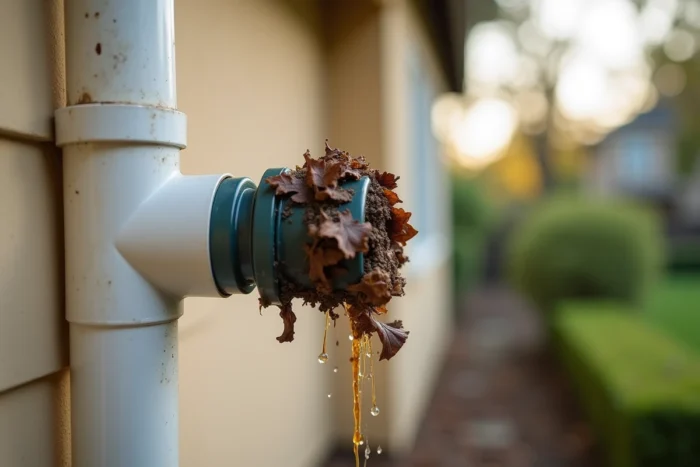
The most common cause of an empty tank is not mysterious: the gutters are blocked. Dead leaves, moss, pine needles, bird nests, anything that accumulates in the channels reduces the flow until it stops. Water overflows over the gutter instead of descending to the collector.
The collector filter poses a similar problem. Its grid retains fine debris (sand, fragments of moss, roofing residues). Without regular cleaning, this grid clogs and blocks the passage of water. On some models, the filter is difficult to access, which discourages maintenance.
The nature of the roof directly influences the rate of clogging. A canal tile roof generates more sediment than a slate roof. Flat roofs with bituminous membranes release micro-particles that clog filters much faster.
- Clean the gutters at least twice a year, ideally before and after autumn, by manually removing debris accumulations
- Dismantle and rinse the collector filter every two to three months, more often if the roof is surrounded by trees
- Install a frog (domed grid) at the entrance of the downspout to block large debris before they reach the collector
- Check that the slope of the gutters directs water toward the downspout connected to the collector, and not toward another downspout
Faulty connection between collector and tank
A poorly made connection remains invisible until the pipes are inspected. The pipe connecting the collector to the tank must maintain a continuous downward slope, without any back slope or low points in between. A pipe that forms a belly retains water and creates an air blockage that prevents the flow from progressing.
The diameter of the pipe also matters. A pipe that is too narrow limits flow during heavy downpours. Water accumulates in the collector, reaches the integrated overflow, and flows back into the downspout. The tank, however, only receives a trickle.
Compression fittings or poorly tightened O-rings cause silent leaks. Water escapes before reaching the tank, often in a location hidden by vegetation or cladding. Running a hand along the pipe during rain helps detect these leaks by touch.
Improperly positioned overflow
The overflow of the tank deserves special attention. If it is installed too low, the tank never fills beyond a fraction of its capacity. The overflow should be a few centimeters below the lid, not halfway up. A drilling error during installation is enough to lose half of the usable volume.
Intermittent rains: when the climate complicates collection
In recent years, several regions in France have experienced episodes of early drought followed by concentrated rains over short periods. This precipitation pattern alters how tanks fill up.
Some recent springs have proven to be very little watered, followed by hot, dry weeks. Rainfall, considered normal for the entire month, actually masked long periods without useful rain to fill the tanks. Violent but brief showers saturate the collector, trigger the overflow within minutes, and then leave the tank to empty through evaporation and regular use.
The overuse of the tank amplifies the problem. With restrictions on the use of drinking water reported by several prefectures since 2025, individuals are drawing more from their reservoir for watering and outdoor uses. The tank empties faster than it fills.
- Always cover the tank to limit evaporation, especially in hot weather
- Adjust the watering frequency to the volume actually available in the tank rather than the needs of the garden
- Consider a second collector connected to another downspout to increase the collection surface

Seasonal maintenance of the rainwater collector
A collector left without maintenance for a year gradually loses its effectiveness. Sediments accumulate at the bottom of the tank and reduce the usable volume. The mud deposit at the bottom of the tank can also clog the withdrawal tap or the outlet to a pump.
Draining the tank once a year, ideally at the end of winter before the collection season, allows for cleaning the bottom and checking the condition of the tap seals. This is also the time to check the non-return valve if the system has one: a valve stuck in the closed position prevents any water entry.
The maintenance of the roof itself is part of the circuit. A roof covered with moss or lichen slows down runoff and releases organic particles that accelerate clogging downstream. Moss removal every two to three years maintains optimal collection flow.
Inspecting the circuit, from the roof to the tank, cleaning the collector filter, and correcting a connection fault are enough to resolve most malfunctions. The climate imposes an additional constraint, but a well-maintained and properly sized system captures every available liter.