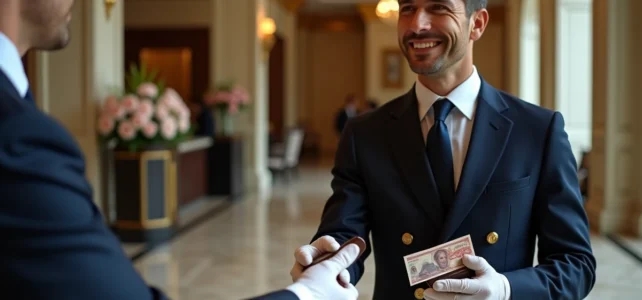
In a 5-star hotel, tipping does not follow a single rule. The expected amount, the timing of the tip, and even the way it is presented vary by country, type of service provided, and local customs. In France, service is included in the bill; in the United States, tips make up a substantial part of staff salaries. This difference in context changes everything, from the discreet gesture to the daily envelope.
Tip in a 5-star hotel: what the host country really changes
Content on the subject often lists amounts without specifying the geographical context to which they apply. A French traveler accustomed to “service included” may find themselves at a loss when faced with the expectations of a New York palace, and vice versa.
In France, tipping remains a voluntary gesture. Service is legally included in the bill and in the room rate. Leaving a few euros for housekeeping or the bellhop is a matter of courtesy, not a social obligation. 5 to 10 euros per night for housekeeping is a reasonable benchmark in a high-end French establishment, with a higher amount justified for a suite or an extended stay.
In the United States, the logic is radically different. Base salaries in the hospitality industry are often below the standard minimum wage, as federal law allows a lower wage floor for employees who receive tips. Not leaving a tip in an American hotel effectively deprives staff of a portion of their expected compensation. Commonly accepted benchmarks are significantly higher than in Europe, and tipping is expected for every service interaction (bellhop, concierge, valet, housekeeping).
Documented practices on the tipping in 5-star hotels according to Eco Voyages confirm this disparity between cultural contexts. In Switzerland, service is generally included in the displayed prices, but rounding up or a small extra is appreciated without being socially obligatory.
Tip amount by type of service in a palace
Tipping in a luxury hotel is not limited to housekeeping staff. Each profession follows its own logic, and the amount adjusts to the service provided rather than a fixed percentage.
Room maintenance
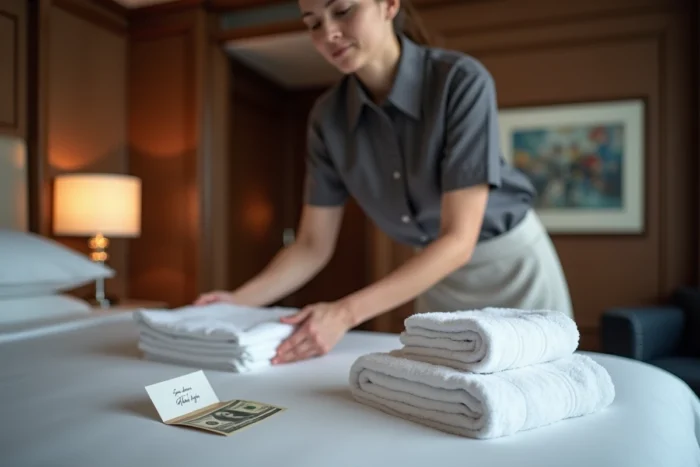
The most documented best practice is to leave a tip each day rather than all at once upon departure. Housekeeping teams rotate: the person who cleans your room on Monday is not necessarily the same one on Wednesday. A single tip at the end of the stay may never reach those who actually maintained your room.
The reference amount for a 5-star hotel is around 5 to 10 euros (or the equivalent in local currency) per night. For a suite or a stay with special requests (additional cleaning, turndown service), a higher amount is justified.
Bellhop, concierge, and valet
These tips are given per service, not per night:
- The bellhop receives a tip each time they handle your luggage, upon arrival as well as departure. The amount depends on the volume of luggage and the complexity of the route to your room.
- The concierge is tipped for exceptional help: hard-to-get reservations, organizing a private transfer, personalized recommendations that took time. A simple routine inquiry does not necessarily warrant a tip.
- The valet receives their tip when they return your vehicle, not at the time of drop-off.
Cash, envelope, or digital payment: how to give a tip in a luxury hotel
The form matters as much as the amount. Tips are preferably given in cash, in an envelope or accompanied by a thank-you note. This gesture, which may seem formal, serves a practical function: it avoids any ambiguity about the destination of the money and allows staff to identify it immediately.
The tip should be placed in a visible spot in the room, typically on the pillow or desk, and not on a cluttered nightstand or in the bathroom. Some hotels provide dedicated envelopes for this purpose.
Field reports vary on the issue of tipping by card or through the hotel app. Some high-end establishments allow you to add an amount to the final bill, but there is no guarantee that this sum will be fully redistributed to the relevant staff. Asking at the front desk how the tip is allocated remains the most reliable approach, especially if you do not have local currency.

Check if service is included before giving a tip
Before any gesture, a check is necessary: is service already included in the bill? In France and several European countries, the mention “service compris” means that part of the bill legally covers staff compensation. Adding a tip is appreciated, but the amount can be modest without awkwardness.
In the United States, this mention is virtually nonexistent in hospitality. Some hotel restaurants automatically add a “gratuity” for large groups, but rooms and ancillary services never include tips in the displayed price.
In Italy or Spain, the intermediate situation can be confusing. The Italian “coperto” covers the cover charge, not the service in the strict sense. Available data do not allow for a general rule for all of Southern Europe: practices vary from one establishment to another, and sometimes from one region to another within the same country.
- Check the detailed bill for a line item “service” or “gratuity” before adding an amount.
- Adjust the tip to the quality of service received rather than a rigid scale: a personalized gesture is worth more than a mechanically applied percentage.
- In case of doubt about local customs, the hotel front desk remains the most reliable source for knowing the practices in place at the establishment.
Tipping in a 5-star hotel relies less on a universal amount than on understanding the local context. A traveler who adjusts their gesture to the country, the type of service, and the manner of giving it avoids missteps without breaking the bank. The only constant, regardless of the country: a daily cash tip reaches the relevant staff better than a lump sum left at check-out.