The current nursing assistant framework is based on the decree of June 10, 2021, restructured around 5 competency blocks and 11 key competencies divided into 10 training modules. The decree of February 26, 2025, strengthened this framework by expanding the scope of authorized actions and requiring an update of competencies for professionals who graduated before 2021.
However, another text, less commented on in the nursing assistant sector, reshuffles the cards: the decree of June 26, 2026, concerning nursing actions. Its direct repercussions on the delegation of care to nursing assistants deserve careful reading.
Nursing decree of June 26, 2026: what changes for delegation to nursing assistants
Most training programs and job descriptions focus on texts specific to the state nursing assistant diploma. The decree of June 26, 2026, however, directly concerns the daily lives of nursing assistants, even though it pertains to the nursing profession.
This text increases the number of nursing actions from 46 to 72, organized into four categories: independent role, actions on prescription, actions on prescription with possible medical presence, and participation in medical actions. By broadening the nursing scope, it mechanically redefines the actions that can be entrusted to nursing assistants within the framework of collaboration.
Among the significant new features: autonomous nursing consultation, an expansion of preventive actions and identification of vulnerabilities, as well as new technical actions such as clinical nursing examination or treatment of chronic wounds. To understand in detail the nursing assistant framework 2026 and the new actions that arise from it, it is necessary to cross-reference these two regulatory texts.

Competency blocks and care actions: articulation between training and practice
The training framework structures the path around 5 competency blocks. Each block groups several modules covering distinct fields: support in daily activities, clinical status assessment, technical care, teamwork, communication, and prevention.
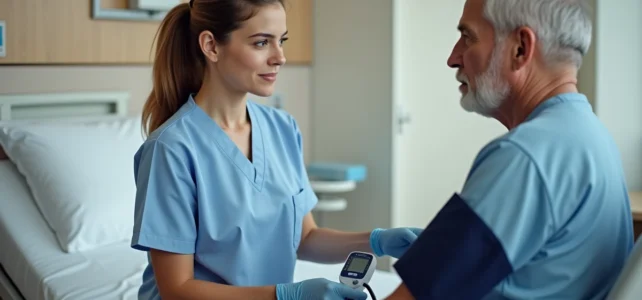
The block related to clinical assessment concentrates the most significant developments. Nursing assistants must now master the monitoring of complete vital parameters: blood pressure, oxygen saturation, respiratory rate, diuresis, and state of consciousness. These actions, once confined to the nursing sphere, have been included in the nursing assistant framework since 2021 and reinforced by the 2025 decree.
Technical actions to be mastered concretely
The list of authorized actions goes beyond simple bathing or meal assistance. The technical care accessible to qualified nursing assistants now includes:
- Measuring and monitoring vital parameters (pulse, temperature, blood pressure, saturation, respiratory rate)
- Participation in the administration of oral therapies, under specific delegation conditions by the nurse
- Identification of anatomical areas related to specific care actions (injection sites, dressing areas)
- Post-care monitoring and actions to take in case of detected anomalies
Each action is performed under the responsibility and in collaboration with the state-registered nurse. The notion of task shifting remains a constant point of vigilance: performing an action outside the scope engages the personal responsibility of the professional.
Obligation to update competencies for nursing assistants graduated before 2021
Professionals holding the DEAS obtained before the 2021 reform do not automatically benefit from the new scope of actions. The decree of February 26, 2025, imposes a competency update training to practice in accordance with the current framework.
This training covers the gaps between the old framework (dating from 2005) and the current one. The 2005 framework did not foresee the autonomous monitoring of vital parameters, nor structured participation in certain technical actions. The transition from one framework to another represents a change in professional posture, not just an addition of actions.
Content and validation of the training
Continuing education organizations (Croix-Rouge Compétence, IFAS, accredited training centers) offer update modules. The program covers the following points:
- Regulatory reminder of the nursing assistant’s role and limits of responsibility
- Practice of clinical monitoring actions introduced by the 2021-2025 framework
- Articulation with the independent nursing role, particularly in light of the decree of June 26, 2026
- Evaluation of acquired competencies, with validation by blocks
Validation is done by competency blocks, allowing for progressive recognition without having to redo the entire initial training. Nursing assistants already in position can follow this update as part of continuing professional education.

Collaboration between nursing assistants and nurses: a legal framework to know
The expansion of nursing assistant actions does not mean total autonomy. Each technical action is part of a collaboration framework defined by the Public Health Code. The nurse remains the pivot of the delegation: they assess the clinical situation, decide to entrust an action, and supervise its execution.
With the decree of June 26, 2026, which increases the number of nursing actions to 72, the collaboration area expands. Nursing assistants are increasingly called upon for monitoring, prevention, and identification tasks. This evolution modifies team organization, particularly in nursing homes and hospital services where the nurse/nursing assistant ratio requires a fine distribution of responsibilities.
The risk of task shifting increases proportionally to the expansion of the scope. A nursing assistant who performs an action not covered by their training or not formally delegated by a nurse exposes themselves to disciplinary and criminal proceedings. The traceability of delegations in the care record becomes a reflex to be ingrained in daily practice.
The nursing assistant framework 2026 is not just a list of additional actions. It reconfigures the place of the nursing assistant in the care chain, with training, traceability, and collaboration requirements that affect both new graduates and experienced professionals.